

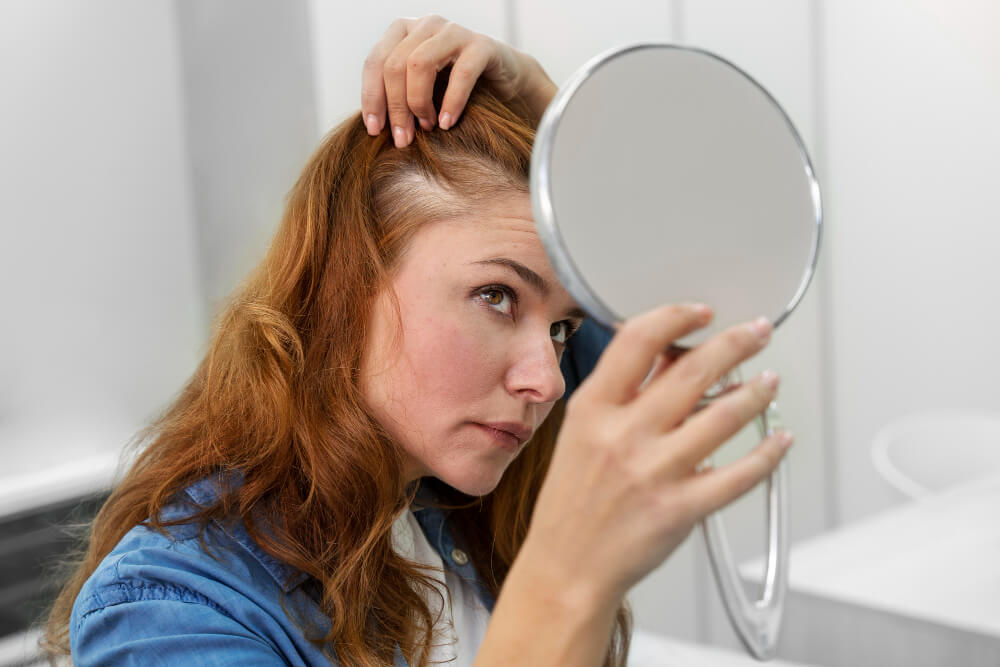
Type “what causes hair thinning” into Google, and you’re really asking something narrower. What’s the one thing I need to fix?
That assumption is baked into the search. And it’s the assumption that trips people up for months, sometimes years.
Short version: what causes hair thinning is almost never one thing. Genetics sets a baseline sensitivity, and hormonal shifts, nutrient deficiencies, scalp inflammation, mechanical stress, or certain medications each act as accelerants on top of it. Which specific cause, or which combination, decides whether the thinning is temporary or permanent.
I’ve read through a lot of dermatology literature on hair loss. One pattern stands out fast. Almost none of it treats thinning as a single-cause event. Clinical reviews talk about triggers, predispositions, overlapping mechanisms.
Consumer articles do something different. They hand you a list of eleven possible causes and let you guess which one applies. Neither approach explains how these causes interact in a real scalp. That’s the part that actually matters.
So instead of another list, here’s the reasoning.
What Causes Hair Thinning to Begin: Genetics Sets the Ceiling, Not the Trigger
Two people can carry the same genetic predisposition to androgenetic alopecia. Same genes, same risk.
One notices a widening part in his late twenties. The other doesn’t see meaningful thinning until his fifties. If genetics were a simple on/off switch, that gap wouldn’t exist.
What’s actually happening is slower. Genetically sensitive follicles don’t die. They miniaturize, cycle after cycle, producing slightly finer and shorter hairs each time until the difference becomes visible.
This is why pattern thinning follows a fairly consistent map. Crown and part-line in women. Hairline and crown in men. It shows up gradually, not all at once.
According to Mayo Clinic, heredity remains the single most common cause of hair loss. But heredity determines susceptibility, not a fixed timeline.
Everything else on this page is really a question of what accelerates that timeline for a given person.
Hormonal Events Look Like Causes But Usually Function as Accelerants
A lot of hair loss content oversimplifies this part. Postpartum shedding, thyroid dysfunction, menopause, PCOS — these get filed under “hormonal causes” as if the hormone itself does the damage.
Sometimes it does. Just as often, though, the hormonal shift exposes a genetic sensitivity that was already sitting there, dormant.
Take postpartum shedding. Nearly every woman experiences some hair loss after childbirth, driven by the drop in estrogen that follows delivery. Most recover fully within six to twelve months.
A smaller subset don’t. And what tends to distinguish them is an underlying genetic predisposition the hormonal event simply brought forward. The hormone was the trigger. The genetics decided how permanent the result would be.
This distinction matters for treatment. If thinning is purely hormonal, correcting the hormone often resolves it completely. If there’s a genetic layer underneath, correcting the hormone helps, but doesn’t finish the job.
That’s why some people fix their thyroid levels, see normal labs, and still notice the hairline hasn’t fully recovered.
The Timeline Trap: Telogen Effluvium and the Delay Nobody Accounts For
If I had to pick the single most misdiagnosed cause of hair thinning, it’s this one.
Not because the condition is rare. Because of a timing quirk that throws almost everyone off.
Telogen effluvium happens when a physical or emotional stressor pushes a larger-than-normal share of hairs out of the growth phase early, into rest. Research on the condition consistently places the visible shedding two to three months after the triggering event. Not immediately after it.
So someone recovers from surgery in March. Feels fine by April. Then starts losing noticeable amounts of hair in June, and naturally blames whatever’s happening in June. A new shampoo. A stressful work week.
The actual cause is already two months in the rearview mirror.
This is a reasoning problem more than a medical one. If you’re trying to figure out what caused a shedding episode, don’t ask “what’s different this week?” Ask “what happened roughly ten to twelve weeks ago?”
Illness. High fever. Major surgery. A crash diet. A big drop in body weight. Extreme emotional stress. Starting or stopping certain medications. These are the categories worth checking against that earlier window.
The good news buried in this diagnosis: telogen effluvium is usually self-limiting. Once the trigger resolves, the hair cycle tends to normalize within several months. That’s a meaningfully different prognosis than pattern thinning.
Nutritional Deficiency Is Real, But It’s the Cause People Reach for First — Often Wrongly
Hair vitamins are a billion-dollar category. That tells you something about how appealing this explanation is.
It’s fixable. It doesn’t require accepting a genetic predisposition or a chronic condition. You just take the supplement.
The evidence is more qualified than the marketing suggests. Low ferritin, the storage form of iron, has a real, repeatedly documented association with diffuse hair loss. A 2022 meta-analysis covering more than 10,000 women found meaningfully lower ferritin levels in women with non-scarring alopecia compared to women without hair loss. That’s a legitimate, evidence-backed cause.
But here’s the reasoning gap that gets skipped. Deficiency-driven thinning is diffuse. It thins the whole scalp somewhat evenly.
It doesn’t produce a receding hairline. It doesn’t isolate to a widening crown. If someone has a clearly patterned thinning distribution and starts taking iron or biotin without ever testing their levels, they’re probably treating a cause that isn’t theirs.
And most people don’t get their ferritin, vitamin D, or thyroid panel checked before reaching for a supplement. Which means they can’t actually know whether they’re addressing the real driver or just hoping.
This is also why supplementing without testing so often disappoints. Nutrition matters. But treating an assumed deficiency instead of a confirmed one is a coin flip.
Mechanical and Chemical Stress — The Causes People Don’t Take Seriously
Traction alopecia doesn’t get discussed with the same weight as genetic or hormonal causes. I think that’s a mistake.
Tight ponytails, braids, weaves, hair rollers. All apply sustained tension to the follicle at the hairline and temples. Early on, this kind of thinning reverses once the tension stops.
Left long enough, it can progress to permanent follicle damage. Sustained mechanical stress eventually triggers the same miniaturization process seen in genetic thinning.
Heat and chemical styling work differently. They don’t usually damage the follicle itself. They damage the hair shaft, causing breakage that looks like thinning even when the follicle is perfectly healthy.
That distinction matters for how someone responds. Breakage from heat styling is a hair-shaft problem, fixed by changing styling habits. Traction thinning near the follicle is a growth problem, and depending on how long it’s been happening, it may need more than a styling change to reverse.
One more thing worth flagging. Someone who already carries a genetic sensitivity and also wears consistently tight styles is stacking two thinning pressures on the same follicles. The mechanical stress isn’t causing the genetic thinning. It’s accelerating it, in exactly the areas already most vulnerable.
When the Scalp Itself Is the Problem, Not the Hair
Most causes discussed so far act on the follicle indirectly. Through genetics, hormones, tension.
Scalp-level causes are more direct. A chronically inflamed or infected scalp can suppress the growth cycle almost independent of anything else going on in the body.
Seborrheic dermatitis is the one I see underestimated most often. It’s usually framed as a cosmetic annoyance, flaking, itching, rather than something that affects hair growth.
But sustained scalp inflammation disrupts the follicular environment enough to shorten the growth phase. Readers who treat the underlying dermatitis sometimes see improvement in shedding that had nothing to do with genetics or hormones at all.
Fungal infections like tinea capitis work through a more direct mechanism. They damage the hair shaft and follicle structure enough to cause patchy loss, and they require antifungal treatment rather than anything scalp-care related.
Medications and Autoimmune Causes Worth Ruling Out Before Assuming Genetics
Alopecia areata gets pulled into “hair thinning” searches constantly. It shouldn’t be lumped in with the rest of this list.
It’s an autoimmune condition. According to Cleveland Clinic, the immune system attacks hair follicles directly, and it behaves nothing like pattern thinning. It tends to appear as distinct patches rather than gradual diffuse thinning or a receding pattern.
Mistaking autoimmune patchy loss for early pattern thinning sends people toward the wrong category of solution entirely. One responds to immune-modulating treatment. The other doesn’t.
Medications deserve a mention too. Mostly because they’re one of the few causes people can identify with certainty just by checking a prescription label.
According to the American Academy of Dermatology, certain blood thinners, retinoids, beta-blockers, and antidepressants are documented to cause hair shedding as a side effect. If shedding started within a few months of a new prescription, that timeline is worth raising with the prescribing doctor before assuming something else is responsible.
What Causes Hair Thinning in Most Real Cases: Two or Three Factors Stacked, Not One
This is really the point the whole article has been circling.
Single-cause thinking produces single-cause fixes. Single-cause fixes are exactly why so many people try one thing, see no meaningful change after a few months, and conclude that nothing works for them.
A common real-world pattern looks like this. Mild genetic predisposition that would have taken another decade to become visible. Combined with a period of low ferritin from months of restrictive eating. Combined with the emotional stress of a hard year.
None of those three alone might have produced noticeable thinning within that timeframe. Together, they did.
Someone in that situation who only fixes their diet, or only starts a genetic-thinning treatment, is addressing one-third of what’s actually happening.
The reasoning shift that helps here isn’t “which cause is mine?” It’s “which combination is mine, and which one is doing the most damage right now?”
A Practical Way to Narrow Down Your Own Cause
Knowing what causes hair thinning in general is only half the job. The other half is figuring out which of these causes applies to you.
A few questions do most of the diagnostic work before you ever need a lab test or a dermatology visit.
Is the thinning patterned, hairline, crown, widening part, or diffuse, even, all over? Patterned points toward genetics. Diffuse points toward hormonal, nutritional, or stress-related causes.
Did it start suddenly or build gradually? Sudden, dramatic shedding usually means telogen effluvium or a medication change. Gradual thinning over years points back toward heredity.
What happened roughly two to three months before the shedding became noticeable? This single question resolves more confusion than almost anything else, given how often people blame the wrong week entirely.
Does anyone in your family have a similar pattern? Family history doesn’t confirm genetics on its own, but it raises the odds considerably.
None of these questions replace an actual evaluation. Sudden, patchy, or rapidly progressing loss, or thinning accompanied by other symptoms like fatigue or irregular cycles, is worth bringing to a doctor rather than reasoning through alone.
But for the ordinary, gradual thinning most people are searching about, working through this sequence usually narrows the field. From eleven possible causes down to two or three genuinely relevant ones.