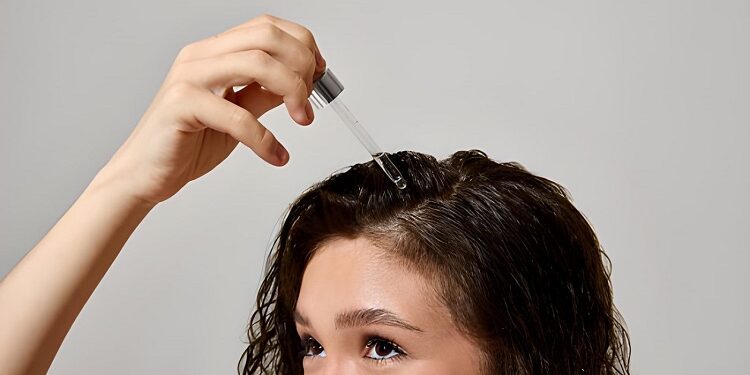


Your Scalp Doesn’t Know What Hair Type You Have
I’ve read through a genuinely embarrassing number of scalp guides while researching this, and almost every one of them is secretly a hair care guide wearing a disguise.
Search “scalp routine for curly hair” and you get one set of instructions. Search “fine hair” and it changes. That implies your scalp behaves differently depending on what’s growing out of it, and honestly, I think that idea has survived this long mostly because it’s convenient content to produce, not because it’s true.
Your scalp is skin. It produces oil, sheds cells, and hosts a microbial community using the same biology whether the hair above it is curly, straight, dyed, or shaved off completely.
I’ll admit I used to sort my own scalp advice by hair type too, years before I started actually digging into the biology. It took embarrassingly long to notice that swapping “curly hair scalp tips” for “oily scalp tips” changed nothing about how my scalp behaved — because the scalp was never reading the label I’d put on it.
Hair type still matters — for how you apply product, how you handle conditioner, how you wash without damaging strands. That’s real, just secondary. The question that actually determines whether a routine works is simpler: what is your scalp doing on its own, independent of what’s attached to it?
The Balance You’re Actually Managing
Here’s a pattern I keep running into in reader messages, and it never stops being a little counterintuitive: the people who wash constantly and the people who barely wash at all often describe the exact same symptoms — tightness, flaking, itching that won’t quit.
That only makes sense once you stop thinking about the scalp as something to clean and start thinking about it as something to balance.
Three things run this system: sebum, the barrier, and the microbiome. Overwash, especially with harsh cleansers, and you strip sebum faster than it regenerates. Underwash, and sebum, dead skin, and residue build up together, shifting the microbiome toward organisms that thrive in dense, oily conditions.
Both paths land in the same place — an irritated barrier, an unbalanced microbiome — just from opposite directions. I find that genuinely more interesting than most people give it credit for. It means “wash more” and “wash less” are both wrong advice in isolation, and neither one means anything without knowing which direction someone’s actually drifting from.
One thing I’ll say plainly, because I think it gets oversold constantly in this space: none of this speeds up hair growth. Growth is controlled by follicle biology and hormones, mechanisms a routine doesn’t reach. What a balanced scalp does is remove obstacles. It doesn’t rewrite what’s happening underneath, and I’m skeptical of anything that claims otherwise.
Do You Actually Need a Routine?
Not every symptom means something’s wrong, and I think the wellness-content industry has done readers a disservice by implying otherwise.
Some oil by evening is expected. A few flakes after a long stretch without washing are normal turnover, not dandruff. Mild itchiness right before wash day usually resolves the moment you cleanse. I’m genuinely tired of seeing normal skin behavior marketed back to people as a problem their $40 serum will solve.
What’s worth addressing: itching that doesn’t fade after washing, flaking that’s persistent rather than occasional, oil that reappears within hours, buildup a normal wash doesn’t clear.
And here’s the distinction most content skips, either out of ignorance or because it’s less profitable to mention: a routine can fix cosmetic and comfort issues. It cannot fix anything that looks diagnosable — intense burning, painful inflamed patches, thick or crusted flaking, hair loss alongside scalp symptoms. I’ve seen readers spend months rotating shampoos for something that had nothing to do with routine at all. If you’ve given a reasonable routine several weeks and nothing’s budged, that’s a sign to get it looked at, not a sign to try harder or buy something else.
Find Your Actual Scalp Type
A message I get constantly: “I have an oily scalp but dry ends, so I must be combination.” I understand why people reach that conclusion, but it’s mixing up scalp behavior with hair behavior.
Sebaceous gland density across your scalp is fairly uniform — you don’t have an oily crown and a dry perimeter the way a face has an oily T-zone. What you usually have is one scalp producing oil at one rate, with the ends drying out from sun, heat, and distance from the root.
Oily shows visible shine within a day of washing. Dry feels tight, sometimes flaky, without oil building quickly even after days unwashed. Sensitive reacts to things that shouldn’t cause a reaction. Normal sits in the middle, genuinely less common than marketing implies — mostly, I’d argue, because “your scalp is fine, do nothing” doesn’t sell anything.
The nuance almost nobody mentions: an oily scalp can still be dehydrated. Oil is a lipid; hydration is water content in skin cells. You can produce plenty of sebum while the underlying skin runs short on water. I think this single mix-up is responsible for more misdiagnosed “combination scalps” than actual combination scalps exist.
Variables That Quietly Change What You Need
A routine that worked in March can stop working by July, and in my experience readers almost never blame the actual cause first. They blame the shampoo.
Season shifts humidity. Hormones move oil production independent of anything you’re doing. Aging generally lowers sebaceous activity, so a routine built for an oilier 20-something scalp can become too harsh for the same scalp at 45 — something I’ve noticed readers rarely revisit until they’re well past the point where it stopped fitting. Exercise and sweat change how fast buildup forms.
None of these mean your routine is broken. They mean the conditions it was built for moved.
The Actual Routine: Daily, Weekly, Monthly
Consistency beats intensity, and if I had to pick one opinion in this entire article I’d defend most stubbornly, it’s this one. A mild routine done daily outperforms an aggressive one done occasionally, every time I’ve looked at how people’s scalps actually respond.
Daily. Wash at your type’s frequency — daily-ish for oily, every two to three days for dry or sensitive. The “wash every other day” rule most articles repeat as universal is hair advice, not scalp advice; it protects color and strand health, not your scalp’s actual needs, and I think it gets misapplied constantly because it sounds authoritative. Apply shampoo at the roots first. Massage with fingertips, not nails, for 30–60 seconds. Rinse longer than feels necessary — leftover surfactant residue keeps working on skin even after you’ve stepped out of the shower, and I’d guess this accounts for a fair share of “sensitive scalp” complaints that are really just under-rinsing.
Weekly. The biggest mix-up I see in scalp care: people exfoliating for “buildup” who actually have barrier irritation, and they’re scrubbing it. Buildup improves right after a thorough wash. Irritation doesn’t fully resolve just from being clean, no matter how hard you scrub. If it’s genuine buildup, physical exfoliation works well, once weekly for oily scalps. If it’s sensitivity, a gentle chemical exfoliant every two to three weeks is safer. Skip it entirely if there’s active irritation.
As needed. Hydration and oil control are separate goals, not opposites. Humectants add water without adding grease. Oils trap moisture that’s already there — they don’t add it, and I’ve watched plenty of oily-but-dehydrated readers make their scalp worse by reaching for oil when what they needed was a humectant.
What Undoes a Good Routine Without You Noticing
A few habits quietly cancel out an otherwise solid routine: nails instead of fingertips, drifting into over- or under-washing without noticing, layering heavy oil onto a scalp already producing plenty, ignoring a symptom for weeks instead of adjusting, stacking too many “light” products that add up to one heavy layer none of them were formulated for.
Two environmental factors I think get underrated: hard water and mineral buildup can leave a coated feeling no shampoo swap fixes — a clarifying wash used occasionally, not weekly, is the right tool. And an unwashed pillowcase re-applies a night’s worth of oil and residue every single night. I find it a little absurd how much attention goes into shampoo choice and how little goes into the fabric someone’s scalp sits against for eight hours a day.
Choose the Version You’ll Actually Keep Doing
The best routine on paper is worthless if you abandon it in two weeks. I’d rather someone follow a mediocre routine for three months than a perfect one for ten days, and I’ll defend that trade every time.
Minimal: wash at your type’s frequency, roots first, real massage, real rinse. Nothing else.
Standard: everything above, plus one weekly layer matched to your actual issue.
Pick whichever one you’ll still be doing in three months.
How to Know It’s Working
Give it real time before judging. Weeks one to two are mostly about stopping the damage, not seeing results. Weeks three to four usually bring the first subtle signals. By weeks six to eight, most cosmetic concerns should show a clear difference if the routine actually matches your scalp.
Compare month to month, not day to day. If nothing’s changed after two full months and symptoms are real, that’s no longer a routine problem worth troubleshooting alone — that’s worth an actual diagnosis instead of another product swap, and I say that as someone who generally prefers figuring things out over booking appointments.