

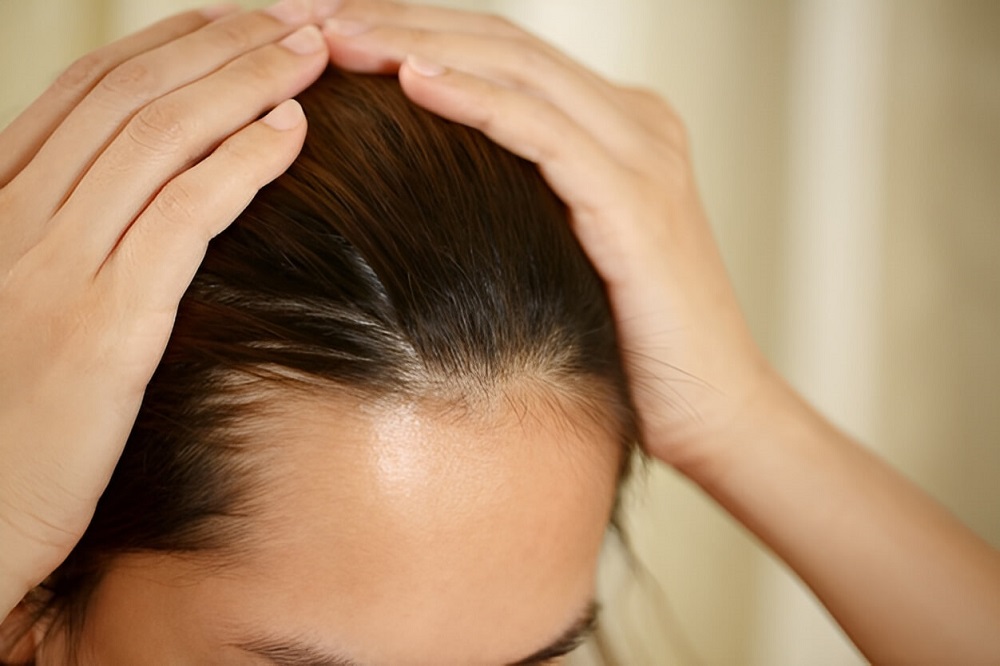
Somebody messaged me last month saying they’d tried eleven different oily-scalp shampoos in eight months. Eleven. Each one worked for maybe a week, then stopped. That’s not a product problem. If eleven different formulas all fail the same way, the formula was never the variable that mattered.
Most greasy scalp advice treats sebum production like a dial. Wash more, wash less, try the next oil-control bottle. But the readers who actually get somewhere aren’t the ones who found the “right” shampoo. They’re the ones who stopped assuming oily scalp is one problem.
It usually isn’t. Often it’s two or three things stacked on top of each other, and they don’t share a fix.
Sebum Production Reacts. It Doesn’t Just Happen.
Here’s something that doesn’t get said enough: sebaceous glands aren’t producing oil at some fixed background rate. They’re reacting — to hormones, to local skin condition, and to something almost nobody accounts for, which is how hard the scalp got stripped during the last wash.
Strip oil too efficiently and the skin doesn’t think “balance achieved.” A lot of the time it reads that as a shortage. Then it overcorrects.
I think this explains a pattern I see constantly. Someone washes daily with a strong clarifying shampoo, trying to get ahead of the oil. Instead they end up locked into a tighter loop — strip, overproduce, strip again. The scalp isn’t malfunctioning in these cases. It’s doing exactly what sebaceous tissue is built to do.
Not Everything Greasy Is Actually Oil
Worth asking before anything else: does this behave like sebum, or does it just look like it?
Silicone-heavy conditioners and styling products can sit on the hair shaft and fake greasiness pretty convincingly. Run a proper clarifying wash and it disappears for a day or two. Actual sebum overproduction doesn’t behave that way — it comes back within 24 hours, almost always concentrated at the roots and crown.
This distinction matters because the fixes don’t overlap. Buildup responds to better cleansing. Overproduction responds to breaking the strip-and-rebound cycle. Treat one like the other and you’ll wonder why nothing works.
Moisture Isn’t What’s Making This Worse
A lot of people assume an oily scalp needs less moisture. Makes sense on paper. Wrong in practice.
Surface oil and barrier hydration run on separate tracks. A scalp can be oily on top and dry underneath, at the same time, in the same person. Keep stripping the surface and skipping conditioner near the roots, and the barrier starts compensating by pushing out more oil.
If your scalp feels oily but also tight — or oily with the occasional flaky patch — that’s not your scalp being confusing. That’s two separate issues sharing one label.
Habits Nobody Thinks to Blame
A few small habits show up over and over in reader routines, and I don’t think people connect them to the oiliness.
Conditioner applied right up to the scalp is the most common one. It’s built for strands, not skin. Daily contact near the roots leaves behind residue that reads as greasiness even when actual oil output is completely normal.
Hot water is another. Feels great in the shower. Strips harder than lukewarm water does, which just feeds the rebound cycle from earlier.
And dry shampoo. Used once in a while, fine. Used every day as a stand-in for actually managing the cycle, it starts layering absorbent particles on top of buildup that’s already there — which is part of why the scalp can feel worse, not better, once it finally gets a real wash.
What’s Actually Behind the Excess Oil
Androgen sensitivity has the strongest case among the usual suspects. Sebaceous glands respond to androgens, and how sensitive someone’s glands are probably explains a good chunk of why two people on nearly identical routines end up with completely different oil levels.
Stress comes up in almost every message I get about this, and there is a real mechanism — cortisol and related hormones do influence sebaceous activity. I’d still file it under secondary rather than primary, though. The research here is thinner and less consistent than its popularity online would suggest.
Diet gets mentioned just as often. Honestly, the evidence connecting specific foods to scalp oil is weak. If you’ve noticed something with a particular food yourself, that’s worth paying attention to. I just can’t turn one person’s pattern into a general rule.
Humidity changes how oil feels and spreads more than it changes how much gets made. That’s a real seasonal experience — sweat and sebum interact differently in humid air — even without any actual shift in gland output.
The Ingredients, and What They’re Actually Doing
Most lists just name these products. Here’s what each one is actually doing on your scalp, and where it falls short.
Salicylic Acid
It loosens the bonds between surface skin cells. That clears buildup and keeps pores from getting clogged with oil and debris.
Useful when accumulation is the bigger issue. Less useful when it’s pure overproduction.
Zinc Pyrithione
Antimicrobial and antifungal. That’s the whole reason it works.
It matters more for dandruff-adjacent oiliness than for oil control by itself. If there’s no fungal or yeast component involved, it’s not doing much for the oil.
Tea Tree Oil
Some antimicrobial support here too, though the research isn’t as deep as it is for the two above.
Concentration is the thing to watch. Too little and it does nothing. Too much and irritation becomes the bigger problem than the oil ever was.
Apple Cider Vinegar Rinses
These adjust surface pH, which can support a healthier scalp microbiome over time.
The specific claim that ACV reduces sebum, though, is mostly anecdotal. I wouldn’t build a routine around it expecting oil control specifically.
None of This Replaces the Routine Fix
Every ingredient above supports a routine. None of them touch the strip-and-rebound cycle on their own. Use them as backup, not as the main plan.
Building a Routine Around the Real Cycle
If stripping and rebound are what’s driving this, the fix is a sequencing change, not a single product swap. Sebaceous glands take weeks to recalibrate. Not days.
In practice: a cleanser that removes oil without maximal stripping, lukewarm water instead of hot, conditioner kept off the scalp itself, and a washing rhythm that stays consistent instead of swinging between extremes.
Consistency does more of the work here than the exact frequency you land on. Most people give a new routine a week, get discouraged, and switch again. Four to six weeks is closer to a fair test.
When It’s Not a DIY Problem Anymore
Persistent flaking alongside the oiliness. Itch that doesn’t go away. A noticeable odor. Thinning concentrated in one spot. Any of these means it’s time for a dermatologist, not another shampoo — they often point toward seborrheic dermatitis or something else where oiliness is a symptom, not the actual issue.
FAQ
Does hair type change how oily a scalp looks? Fine hair shows oil faster since there’s less volume to absorb it visually. Thicker or coarser hair can hide the same amount of oil for longer. It’s a visibility difference, not a production one.
Does oily scalp get better with age? Sebaceous activity tends to run higher through adolescence and young adulthood, then ease off gradually for a lot of people later on. Individual variation is wide enough that nobody can promise this for any one person.
Is switching shampoos often a bad idea when trying to fix this? Pretty much, yes. It makes it hard to tell whether anything is working, since sebaceous adjustment takes weeks. One consistent approach, given enough time, beats constant brand-hopping.