

Table of Contents
Key Takeaways:
- Scalp inflammation isn’t one condition — it has at least four distinct triggers (barrier damage, yeast overgrowth, autoimmune activity, allergic reaction), and matching the remedy to the actual cause matters more than the remedy itself.
- Chronic scalp inflammation isn’t just a comfort issue — it’s linked to hair shedding, and may even blunt how well treatments like minoxidil work in pattern hair loss.
- “PPD-free” hair dye doesn’t always mean allergy-safe — many substitutes cross-react with PPD in roughly half of allergic users.
Most searches for “scalp inflammation remedies” start from the same assumption: that inflammation is one problem, and somewhere out there is one fix for it. I understand why. It’s a tidier way to think about it.
But that assumption doesn’t hold up against what’s actually happening on your scalp. Inflammation is a downstream symptom, not a root cause — it’s your immune system reacting to something. And depending on what that something is, you’re looking at four genuinely different mechanisms: a damaged moisture barrier, a yeast overgrowth, an autoimmune process, or an allergic reaction to something that touched your skin.
This isn’t a small distinction. A remedy built for one of these can do nothing for another, and in some cases, actively work against you. Antifungal shampoo won’t touch psoriasis. A steroid cream can mask a fungal infection long enough to let it get worse. Switching hair dyes after an allergic reaction doesn’t help if the replacement product contains a near-identical allergen.
So instead of handing you another list, I want to start where the diagnosis actually starts — with what your scalp is showing you — and work outward from there.
01
of 10First, What Kind of Inflammation Are You Actually Dealing With?
Before you try anything, look closer. Not at how bad it feels — at what it actually looks like.
Three things matter here: oil, color, and timing. Is the scalp dry or greasy? Are the flakes white, yellow, or silvery? And did this start after something changed — a new shampoo, a dye job — or did it build up on its own?
That’s the whole diagnostic engine. Everything below maps to it.
Dry, Tight, Flaking
No oil involved. Just tightness, then flaking.
This usually isn’t inflammation in the technical sense. It’s barrier damage. Over-washing, hard water, harsh sulfates, cold air — any of these can strip oils faster than your scalp can replace them.
The skin responds the only way it knows how. It flakes. It can look worse than it is.
Greasy Scales, Yellow Flakes
Now add oil to the picture. Flakes that are yellowish, somewhat large, clustered around the hairline and behind the ears.
This is the classic presentation of seborrheic dermatitis. The driver is Malassezia — a yeast that lives on every scalp, harmlessly, until it doesn’t.
It feeds on sebum. That’s why it shows up where oil does.
Thick Silvery Plaques, Sharp Borders
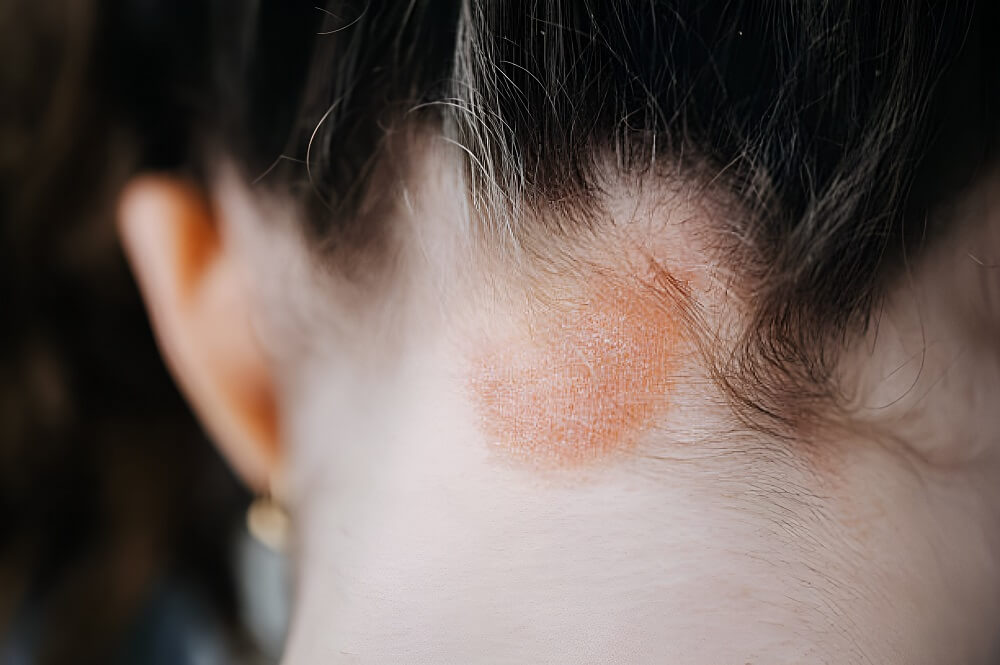
Different texture entirely. Thicker. More stubborn. And the edges are sharp — almost like someone drew a line around them.
That border is the tell. Psoriasis is autoimmune, not fungal, and the mechanism is completely different: skin cells are being produced far faster than they can shed.
Sharp borders, thick adherent scale, often somewhat silvery in color. That combination points here.
Tender Bumps or Pustules
This one doesn’t look like flaking at all. It looks like acne.
Small red bumps. Sometimes a visible point of pus at the center. Each one centered on a hair follicle — that’s the detail that separates it from ordinary acne.
This is folliculitis. Bacterial or fungal, usually. Either way, it’s an infection of the follicle itself, not a surface issue.
Burning or Stinging After a Product Change
Timing is everything here.
Did the burning start within hours of using a new product? A day or two later? That window — hours to a few days — is the signature of contact dermatitis.
It’s allergic or irritant, and hair dye is one of the most common culprits, particularly PPD. The product touched your scalp, your immune system flagged it as a threat, and now it’s reacting.
No product change, no timing pattern? Probably not this one.
02
of 10Why “Just Calm It Down” Isn’t the Right Goal
Here’s something that took me a while to really sit with.
Inflammation isn’t the disease. It’s the response.
Your immune system identified something — a yeast overgrowth, an allergen, a compromised barrier letting irritants in — and it’s reacting. The redness, the itching, the burning. That’s the alarm, not the fire.
This changes how I think about “calming” a scalp down.
Aloe vera feels good. It cools the skin, eases the sting, brings the redness down a notch. I’m not knocking that — comfort matters, especially when something’s actively bothering you.
But it doesn’t touch the yeast. It doesn’t stop the allergen. It doesn’t repair the barrier.
So the alarm goes quiet for a bit. Then it comes back.
I’ve seen this pattern come up again and again in how people describe their scalp issues — weeks of feeling better, then a flare, then the same remedy, then another flare. It’s not that the remedy failed. It’s that it was never aimed at the actual trigger.
Which is why I think the better question isn’t what calms this down. It’s what’s provoking my immune system — and does this remedy actually address that, or just the alarm it’s setting off.
Small shift in framing. Big difference in what you reach for next.
03
of 10The Inflammation–Hair Loss Connection
This is the part I find genuinely underexplained. Not because the research is thin — it isn’t — but because most scalp content treats hair loss and inflammation as separate topics. They’re not.
There are at least three distinct mechanisms here. Different stakes for each one.
Telogen Effluvium
Start with the reversible version.
A significant inflammatory event — a bad seborrheic dermatitis flare, a severe allergic reaction, even a high fever — can push hair follicles prematurely into the resting phase of the growth cycle. Telogen, specifically.
The shedding shows up later. Often two to three months after whatever triggered it.
That delay is exactly why people miss the connection. They’re not shedding during the flare. They’re shedding long after it’s resolved, wondering why their hair is suddenly falling out for no reason.
There usually is a reason. It’s just two months old.
The good news: once the trigger resolves, this type typically reverses on its own.
Microinflammation in Pattern Hair Loss
Here’s the detail that surprised me most while researching this topic.
Androgenetic alopecia — ordinary pattern hair loss — has always been classified as non-inflammatory. Genetics and DHT sensitivity, full stop. That’s the textbook story.
Except biopsy studies keep complicating it.
Perifollicular inflammatory infiltrates — inflammation clustered around the base of the follicle — show up in a majority of AGA biopsies across multiple studies. Some report it in well over 70% of samples.
That’s not a fringe finding. That’s most of the samples.
And here’s where it gets practically relevant, not just biologically interesting: one frequently cited study found that men with visible microinflammation around their follicles had a meaningfully lower minoxidil response rate. Roughly 55% saw regrowth, compared to 77% in patients without inflammatory signs.
Read that again. Same treatment. Same condition. A 22-point gap in who it actually worked for — and inflammation status seems to be part of why.
I want to flag the honest limit here. This shows association, not proven causation. Researchers don’t yet know if the inflammation is driving the miniaturization, is a side effect of it, or both feed into each other in a loop. It’s an active research area, not a settled mechanism.
But even with that caveat, the implication is hard to ignore: treating scalp inflammation might not be a separate task from treating hair loss. It might be part of giving your existing treatment a fair shot at working.
Cicatricial Alopecia
Now the version where the stakes go up considerably.
In chronic, untreated inflammatory conditions — folliculitis decalvans is the classic example — sustained immune activity around the follicle can eventually destroy the stem cells that regenerate hair.
This isn’t dormancy. It’s not “resting” like telogen effluvium.
The follicle itself is gone.
That’s the line I’d draw between “annoying” and “urgent.” Short-term irritation, even uncomfortable irritation, usually isn’t dangerous to the follicle long-term. Chronic, unaddressed inflammation is a different category entirely — especially if it’s persistent, painful, or leaving behind smooth bald patches.
The Takeaway
Three mechanisms, three different risk levels.
Telogen effluvium: usually reversible, just delayed. Microinflammation in pattern hair loss: still being understood, but potentially undermining treatments you’re already using. Cicatricial alopecia: the one where waiting has a real cost.
Put together, they point to the same conclusion. Inflammation control isn’t a side quest from hair growth strategy. For a lot of people, it’s foundational to it.
04
of 10Immediate Relief (While You Figure Out the Cause)
If your scalp is burning right now, you don’t need a diagnosis first. You need it to stop hurting for a minute.
A few things genuinely help, without making the underlying picture harder to read later.
Lukewarm water, not hot. I know hot water feels better in the moment. It also strips oils and increases blood flow to skin that’s already irritated — which tends to make the itching and redness worse, not better, once the shower ends. Small change. Bigger impact than it sounds like it should have.
Aloe vera gel. Pure aloe, not the heavily fragranced version sold next to it on the shelf. There’s a reasonable evidence base here for reducing redness and easing that stinging sensation, largely through its cooling effect. Fragrance, on the other hand, is one of the more common contact irritants out there — so check the label before you reach for it.
Witch hazel. Applied with a cotton pad. Astringent, which means it can cut down on surface inflammation and oil. Particularly useful if your scalp runs oilier.
Now, what to skip.
Hot water. Already covered, but worth repeating because the urge is strong when something itches.
Scratching. Obvious advice, hard to follow. But scratching breaks skin that’s already compromised, which opens the door to secondary infection — turning a manageable irritation into something that needs more than home care.
Layering several new actives at once. This is the one I’d flag hardest, because the instinct makes sense and the result backfires anyway.
When something hurts, you want to throw everything at it. Tea tree oil, a new medicated shampoo, an apple cider vinegar rinse, all in the same week.
Here’s the problem. If you react badly to any of it, you won’t know which ingredient caused it. You’ve just made your own diagnosis harder, right when you need it to get easier.
One change at a time. A few days to watch what happens. Slower, yes. But it’s the only way to actually learn what your scalp is responding to — instead of guessing all over again next time.
05
of 10Root-Cause Remedies, Matched to Trigger
Once you have a working idea of what’s driving things, the remedy should target that mechanism specifically. Not just the category. The mechanism.
Here’s how the major options actually work.
Seborrheic Dermatitis
The core issue is yeast, not dryness. So the most effective remedies are antifungal — not soothing, not moisturizing. Antifungal.
Ketoconazole 2% and ciclopirox 1% work by disrupting the cell membrane of Malassezia directly. That’s the mechanism. You’re not calming inflammation here — you’re reducing the population of the organism that’s causing it in the first place.
This is why prescription-strength options tend to outperform milder ones in stubborn cases. They’re hitting the actual cause.
Pyrithione zinc and selenium sulfide also have antifungal action, just gentler. These are the workhorses of OTC dandruff shampoos, and for mild cases, they’re often enough. Reserve the prescription-strength antifungals for when these don’t cut it.
Coal tar is the odd one out. Different mechanism entirely — it slows the excessive skin cell turnover that contributes to scaling. Less common now, mostly because of the smell and staining, and because better-tolerated alternatives exist.
Psoriasis
Different cause, different toolkit. Psoriasis is autoimmune, not fungal — antifungal shampoos won’t touch the root issue here.
Though they can sometimes help with secondary yeast involvement. That’s genuinely common on a scalp that’s already inflamed and disrupted.
Topical corticosteroids are the primary treatment, and potency is the detail most consumer content glosses over entirely.
Mild options — hydrocortisone, for instance — suit sensitive areas or short flares. Higher-potency options like clobetasol are for thicker, more resistant plaques, usually under some guidance on duration. Prolonged use of high-potency steroids carries its own risks, skin thinning being the main one.
It’s not “steroids work” or “steroids don’t.” It’s matching potency to severity.
Calcineurin inhibitors — tacrolimus and pimecrolimus — take a different route. They suppress the immune signaling that drives inflammation, without the skin-thinning risk steroids carry.
That’s exactly why they’re often used for longer-term management. Safer for sustained use, even if they tend to work more slowly in an acute flare.
Salicylic acid isn’t treating the immune dysfunction at all. It’s mechanical — breaking down the bonds between dead skin cells so thick plaques lift more easily. Useful for getting other treatments to actually penetrate, not a standalone fix.
Folliculitis
Depth determines the approach here.
Superficial, limited bumps may respond to topical antibacterial or antifungal treatment — worth confirming which one you’re actually dealing with rather than guessing, since the wrong topical does nothing.
But folliculitis that’s deep, widespread, or simply not improving often needs oral antibiotics or antifungals. Topical treatment frequently can’t reach far enough to address an infection sitting deeper in the follicle.
This is one of the clearer lines where home care should give way to a prescriber. If it’s spreading, painful, or not budging after a reasonable stretch of topical treatment, that’s the signal.
Contact Dermatitis and the PPD Problem
This one deserves more nuance than most coverage gives it.
Para-phenylenediamine — PPD — is the most common hair dye allergen. Reactions typically show up hours to a few days after exposure: itching, redness, sometimes blistering at the scalp, hairline, and ears.
The standard advice once someone identifies a PPD allergy is straightforward. Switch to a “PPD-free” dye.
Here’s the catch, and it’s the detail I think gets genuinely underreported.
Many PPD-free dyes substitute a related compound called toluene-2,5-diamine sulfate, or PTDS. The molecules are similar enough that roughly half of people allergic to PPD will also react to PTDS.
Half.
So if you’re PPD-allergic and you switch to a “PPD-free” product without checking what actually replaced it, there’s a real chance you haven’t solved anything. You’ve just renamed the problem.
The practical fix isn’t trusting the label. It’s patch testing the specific replacement product, or working with a dermatologist to find dyes built on genuinely different chemistry.
For an active reaction, treatment generally mirrors other contact dermatitis cases: removing the offending product, gentle cleansing, and a short course of topical or oral corticosteroids if things are severe enough to warrant it.
06
of 10Evidence-Based Natural Remedies — What’s Actually Supported vs. Folklore
This is where a lot of scalp content either oversells or dismisses outright. I’d rather walk through what the evidence actually supports, ingredient by ingredient.
Tea tree oil has decent evidence behind it for antiseptic and mild antifungal action. That’s part of why it shows up in some medicated dandruff formulas.
But it’s also one of the more common causes of allergic contact dermatitis among “natural” ingredients — especially used undiluted. A 24-hour patch test on a small patch of skin, not your whole scalp, isn’t optional caution here. Given how often reactions actually happen, it’s a necessary step.
Coconut oil has documented antimicrobial properties and can genuinely help with barrier-related dryness. Worth knowing, though: it’s comedogenic for some scalp types, meaning it can clog follicles in people prone to that.
Good fit for dry, flaky scalps. Less ideal if oiliness or folliculitis-type bumps are part of your picture.
Apple cider vinegar gets credited with restoring scalp pH. ACV is mildly acidic, and there’s some antimicrobial plausibility there.
But the pH-balancing claim tends to get overstated relative to what’s actually been shown. Reasonable, low-risk option for some types of flaking. Not a verified treatment for diagnosed conditions like seborrheic dermatitis or psoriasis.
Baking soda pastes show up often for dandruff-related itching. Here’s my concern: baking soda is alkaline, and your scalp’s natural pH runs slightly acidic. Disrupting that on a barrier that’s already compromised can irritate things further.
I’d treat this one with more skepticism than enthusiasm.
Warm oil treatments — mineral, olive, peanut oil — aren’t medicinal the way antifungals or steroids are. They work mechanically. Heat and oil soften thick, adherent scale so it lifts more easily during washing.
Supportive step. Not a standalone remedy.
The Microbiome Angle
This is the area I’m watching most closely, because the underlying biology is genuinely interesting. But I want to be upfront about where the evidence actually stands — this is exactly where marketing tends to outrun research.
The scalp hosts a complex community of bacteria and fungi. Disruption of that balance — particularly Malassezia overgrowing relative to beneficial bacteria like Lactobacillus — appears linked to seborrheic dermatitis, and possibly to broader inflammatory patterns.
Small studies have tested probiotic-based topical treatments, with some encouraging early results. One short trial used an oily suspension containing two specific probiotic strains in 25 seborrheic dermatitis patients, tracking symptom severity and microbiome shifts over about three weeks, and found symptom improvement alongside a reduction in the Malassezia population. That’s a real, published finding, and it’s encouraging.
But it’s worth being precise about what this is and isn’t. A small short-term study isn’t a large randomized trial. “Microbiome-friendly” ointments combining probiotics, honey, or turmeric are still investigational, not established treatments.
I’d call this a promising adjunct to watch. Not a replacement for treatments with a longer track record — at least not yet.
07
of 10The Overlooked Trigger: What’s Touching Your Scalp Every Day
Sometimes the most useful remedy isn’t something you add. It’s something you remove.
Sulfates strip the scalp’s natural oils efficiently — that’s literally what they’re designed to do. Efficient cleaning, yes. But on a scalp already prone to dryness-driven inflammation, that efficiency works against you.
Fragrance is one of the most common contact allergens across hair and skin products, full stop. And it’s frequently overlooked, because it’s listed as one vague word on an ingredient label rather than something that sounds obviously suspicious.
Hair dye chemistry deserves more scrutiny than a “PPD-free” label alone provides — we covered why in the section above. The substitute isn’t automatically safer just because it has a different name.
If you’re dealing with irritation that keeps coming back and you can’t quite pin down why, an elimination approach tends to be more revealing than adding another remedy on top of an unresolved trigger.
Remove one product category at a time. Give it a week or two. Track what actually changes.
It’s slower than reaching for something new. It’s also the only approach that tells you, with any confidence, what’s actually causing the problem — instead of guessing again next month.
08
of 10Does Diet Actually Help?
Some, yes. Not as much as headlines suggest.
Omega-3 fatty acids — salmon, walnuts, flaxseed — are reasonably well supported as part of a broader anti-inflammatory dietary pattern. There’s genuine biological plausibility for some benefit to skin and scalp health through that pathway.
Antioxidant-rich foods fit the same logic. Part of a generally supportive pattern, not a targeted treatment for any specific scalp condition.
Here’s what I want to be honest about, though: diet is supportive, not curative.
I haven’t seen credible evidence that dietary changes alone resolve diagnosed conditions like seborrheic dermatitis or psoriasis. If you’re dealing with one of those, food choices are one piece of a broader approach — not a remedy in their own right.
Worth doing for general health regardless. Just don’t expect it to replace the root-cause remedies covered earlier.
09
of 10When to Stop Self-Treating and See a Dermatologist
A few signs genuinely warrant professional care instead of continued home treatment.
Oozing or weeping from affected areas. This can signal a secondary infection on top of whatever started the irritation.
Painful pustules, especially if they’re spreading or not improving after a few days.
Smooth, shiny bald patches without visible follicle openings. This is worth taking seriously — it can indicate scarring alopecia, where the damage may not be reversible. Time matters more here than with most scalp issues.
Symptoms that persist or worsen despite several weeks of appropriate home treatment. If you’ve matched the remedy to the cause and nothing’s shifting, that’s information too.
Spreading rash, fever, or visible swelling. These can point to a more significant infection than topical care is equipped to handle.
One more thing worth building into your routine, not just reading once and forgetting: before trying any new natural active — tea tree oil especially — patch test it. Apply a small amount to your inner forearm. Wait 24 hours. Only move to your scalp if nothing happens.
It takes a day. It saves you from finding out the hard way.
10
of 10The Practical Takeaway
Scalp inflammation isn’t one problem with one fix. It’s an immune response, and it has several possible triggers — each one calling for a different remedy.
Dry and flaky calls for barrier repair. Greasy and yellow calls for antifungal action. Thick silvery plaques call for immune-modulating treatment. Sudden burning after a new product calls for finding the trigger — and checking what actually replaced it, since substitutes aren’t always as different as their labels suggest.
Match the remedy to the cause. Give it real time before judging whether it’s working. Watch for the red flags above.
And if hair thinning is part of your picture alongside the irritation, treat the inflammation as part of your hair health strategy. Not a separate cosmetic annoyance to deal with later.
The research on microinflammation in pattern hair loss is still developing. But it points toward something genuinely practical: an inflamed scalp may simply be a harder place for hair growth treatments to do their job.