

Table of Contents
A weekend project turned slightly obsessive. I pulled every long-running telogen effluvium recovery thread I could find on Reddit — r/TelogenEffluvium, r/FemaleHairLoss — and read them start to finish, not just the top comment.
Advice wasn’t the goal. Timing was: when did people say the shedding had stopped, and did it actually stay stopped?
The pattern that jumped out wasn’t the range of recovery times — everyone knows that varies. It was how often people described the same emotional sequence. Shedding slows, hope returns, a few good weeks pass, baby hairs appear along the part. Then, without warning, it comes back — sometimes worse.
One person called it a “false end.” That phrase stuck, because it wasn’t describing a relapse. It was describing an ending that turned out not to be real.
Most clinical descriptions of telogen effluvium treat it as a single wave: trigger, shed, resolve. According to the International Society of Hair Restoration Surgery, the condition is typically self-limited — but the forum data doesn’t look like one clean wave. It looks like two, separated by a genuinely convincing quiet period.
Back into the hair-cycle literature I went, specifically looking for anything on recurrent or biphasic shedding. That search is the reason this guide is built around two separate questions instead of one — when does shedding actually stop, and when does density actually come back.
I’m an independent scalp researcher, not a clinician. My work here synthesizes peer-reviewed hair-cycle science with patterns observed across reader questions and recovery forums, and where the evidence runs thin, I’ll say so directly.
1 What’s Actually Happening in the Hair Cycle
Telogen effluvium happens when a disproportionate number of hairs get pushed prematurely from the growth phase into the resting phase, then shed together weeks or months later. This timing is the key to understanding telogen effluvium recovery, because most of the confusion people run into starts here.
From Anagen to Telogen — The Premature Shift
Hair normally cycles through three phases. Anagen is active growth, lasting several years for most follicles. A short transitional catagen phase follows, then telogen (rest), which precedes shedding.
At any given time, roughly 10–15% of your hair sits in telogen. That’s your normal daily shed of 50–100 hairs.
A stressor changes that ratio, though sources frame the shift differently. Some describe up to 30% of total hair moving into telogen at once; others describe up to 70% of hair already in the anagen phase being cut short and pushed into telogen early. Either way, the shift is large enough to push shedding well above the normal daily share — the mechanism behind the dramatic, handful-in-the-shower shedding that defines TE.
Why Shedding Lags the Trigger
Shedding doesn’t start the week of the stressor. It starts later, because the telogen phase itself lasts for a while before the hair actually releases.
Clinical sources don’t fully agree on how long that lag runs. Some place onset as early as four to six weeks after the stressor; others, including Cleveland Clinic, describe onset occurring roughly two to three months out.
What they do agree on is the direction: onset is delayed, not immediate. That’s exactly why so many people tracking their own telogen effluvium recovery never connect their hair loss to something that happened weeks or months earlier. If you’re trying to identify your own trigger, look back several months rather than several weeks.
More on this delayed-onset mechanism lives in why nothing shows for eight weeks after a hair growth trigger, if you want the fuller picture of hair-cycle timing.
2 Telogen Effluvium Recovery Timeline: Expectation vs. Reality
Three to six months is the number most often quoted for telogen effluvium recovery, with acute telogen effluvium resolving on its own in the majority of cases. That figure is accurate, but it describes an average, not a guarantee — and it’s easy to misread what it’s actually measuring.
The Clinical Average
Shedding tends to peak three to four months after the triggering event. In total, it typically lasts three to six months, with fuller volume returning over 6–12 months once the underlying cause resolves.
Acute telogen effluvium is defined as lasting under six months. A separate clinical figure — cited by the ISHRS — estimates that about 95% of patients fully recover within two to three months of the stressor actually resolving.
That’s an important distinction. The 95% statistic measures time since the trigger ended — not time since shedding was first noticed. Someone counting from the day they first saw hair in the drain is running a different clock than the one that number is built on, and conflating the two is a common source of false alarm about telogen effluvium recovery timing.
What Telogen Effluvium Recovery Threads Actually Show
“Shedding stopped” ranged widely across the accounts reviewed — as early as four months in some cases, well past a year in others. Several long-runners described shedding that continued intermittently for two to three years before finally settling, territory that starts to overlap with chronic telogen effluvium.
One account described a roughly four-month episode where regrowth became visible while shedding was still tapering off, not after it had fully stopped. That overlap matters, because the two processes don’t run in a clean sequence.
| Stage | Clinical Expectation | What Recovery Accounts Report |
|---|---|---|
| Shedding onset | Weeks to a few months post-trigger | Often unnoticed until well past the trigger |
| Peak shedding | Month 3–4 | Varies widely; some describe two distinct peaks |
| Shedding stops | By month 6 | Commonly 6–14 months; longer in chronic cases |
| Visible density returns | 12–18 months | Frequently longer, especially after repeated episodes |
A timeline that doesn’t match the six-month average isn’t automatically a red flag. It falls within documented normal variation — something standard clinical summaries rarely spell out.
3 The False End: Why Shedding Doubles Back
A second wave of shedding after apparent recovery is a real, recurring pattern that complicates telogen effluvium recovery for a lot of people. It may be driven less by a new physical trigger and more by the psychological aftermath of the first episode.
The Pattern Across Recovery Accounts
Multiple long-running threads describe an almost identical arc. Shedding slows for weeks, sometimes a full month, complete with new baby hairs at the hairline — then returns, occasionally worse than before.
Several people independently speculated that the stress of the first shed had triggered a second one. Nobody prompted this theory; it surfaced separately, in separate threads, without medical guidance behind it.
That kind of independent convergence is worth paying attention to. It suggests a pattern rather than a coincidence — and, notably, it lines up with published case documentation, not just forum speculation.
Stress From the Shed Itself
The anagen-to-telogen shift is a stress response, and what counts as “stress” to a follicle isn’t limited to the original illness or life event. Watching your hair fall out is stressful in its own right.
A case report published in Skin Appendage Disorders tracked a patient’s chronic telogen effluvium against his emotional events over 31 months and found that emotional strain corresponded directly with relapse severity — the first graphic documentation of this intermittency and its likely link to emotional strain. That’s a meaningfully stronger basis than anecdote: a clinician specifically set out to test whether emotional stress predicts relapse, and found that it does, at least in this documented case.
This is still worth stating carefully. It’s one case report, not a large-scale study, and it doesn’t mean every relapse has an emotional trigger. But it does mean the “stress from the shed itself” pattern described across recovery forums has a real, published parallel — not just internet speculation.
If it holds up more broadly, it reframes the “false end” as a second real TE episode layered on top of the first. It isn’t proof the original diagnosis was wrong, and it isn’t proof telogen effluvium recovery is impossible.
4 Signs of Telogen Effluvium Recovery
Sustained reduction matters more than any single good shower. That’s the most reliable sign of genuine recovery, and it’s easy to miss because early relief feels so convincing.
A quiet week is exactly what tends to precede a false end in the accounts reviewed here. A pull test — gently tugging a small clump of 40–60 hairs — recovering to only two or three hairs coming away, and staying there for three or more weeks, is a far stronger signal than any single day’s count.
Signs of Genuine Recovery
Pull test yields 2–3 hairs or fewer, consistently, over 3+ weeks
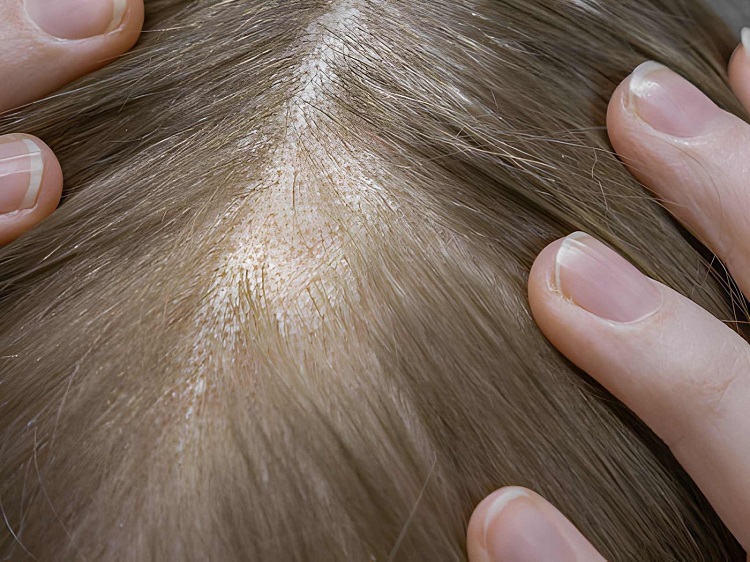
Visible baby hairs along the hairline or part — not just isolated new strands
Shower and brush shedding matches your pre-TE baseline for multiple consecutive weeks
Ponytail circumference is stable or increasing over a month
No new identifiable stressor — illness, diet change, medication, major life event — introduced recently
Baby hairs that seem stalled rather than progressing raise a separate question. The diagnostic differences are covered in baby hairs not growing.
5 When It’s Not Just TE: Ruling Out Chronic TE or AGA
Shedding that persists past six months doesn’t automatically mean androgenetic alopecia. It does mark the point where a proper differential diagnosis matters.
Chronic vs. Acute Shedding
Chronic telogen effluvium is defined as lasting longer than six months, affecting the entire scalp, often without a single identifiable cause. Short anagen syndrome is thought to underlie it — a shortened growth phase that leads to more frequent hair cycling overall.
Patients with this pattern often notice an inability to gain length, along with persistent short hairs at the hairline.
Telogen Effluvium vs. Androgenetic Alopecia
Rapid, diffuse shedding a few months after a stressor points toward telogen effluvium. Androgenetic alopecia progresses more gradually and, without treatment, doesn’t reverse on its own.
Dermoscopy tells the two apart more reliably than symptoms do. Androgenetic alopecia shows greater variability in hair shaft caliber and more pronounced miniaturization compared to isolated TE — a distinction visible on a scalp exam, not something you can self-diagnose from shedding patterns alone.
A scalp biopsy or dermoscopic exam is the tool that actually separates these two conditions when shedding stays diffuse and non-patterned past six months. More self-monitoring won’t resolve that question. For thinning-location context, see hair thinning in front for women and hair crown thinning.
6 What Actually Supports Telogen Effluvium Recovery
Correcting an identified deficiency is the single most evidence-supported lever available. It outperforms any topical product or supplement stack marketed specifically for shedding.
Addressing Nutrient Deficiencies
Deficiencies in iron, vitamins B and D, zinc, protein, and essential fatty acids can lower stress tolerance and extend TE’s duration. Bloodwork — particularly ferritin, vitamin D, and TSH — identifies whether one of these is actually a factor, rather than guessing through trial-and-error supplementation.
Which specific vitamins have real evidence behind them, versus marketing hype, is covered in hair growth vitamins that work.
Managing the Stress-Shedding Feedback Loop
Stress management isn’t a soft, optional add-on if the false-end mechanism holds. It’s addressing a plausible second trigger directly, and by extension, supporting telogen effluvium recovery on the timeline the biology actually allows.
Anxiety around shedding is sometimes overlooked as a treatment target, but the case data above suggests it deserves to be considered a legitimate one. This won’t feel as satisfying as a supplement or serum — no argument there.
But given the feedback-loop mechanism, reducing daily hair-checking behaviors may do more for your actual timeline than another product will. For hormonal contributors, see hormones and hair growth; for postpartum-specific timing, postpartum hair loss covers that in more depth.
Frequently Asked Questions About Telogen Effluvium Recovery
Can telogen effluvium come back after it stops?
Yes — this is a well-documented pattern in recovery accounts, sometimes called a “false end,” and it has a real published parallel in a case report tracking emotional strain against relapse severity. A genuine quiet period can be followed by a second wave of shedding, possibly driven by the stress of the first episode rather than a new, unrelated trigger.
How do I know if telogen effluvium recovery is really happening?
Look for a sustained pull-test improvement — two to three hairs or fewer, held consistently over three or more weeks. Visible baby hairs at the hairline and shedding back at your pre-TE baseline are supporting signs.
What’s the difference between telogen effluvium and androgenetic alopecia?
Telogen effluvium causes diffuse, non-patterned shedding months after a stressor, and typically resolves on its own. Androgenetic alopecia progresses gradually, follows a pattern (frontal or crown-predominant), and doesn’t reverse without treatment.
Can chronic telogen effluvium last years?
Yes. Acute TE resolves within six months in most cases, but chronic TE can persist for a year or longer, and clinical literature describes it as capable of fluctuating over a period of years.
Should I get bloodwork for shedding like this?
It’s a reasonable request — particularly for ferritin, vitamin D, and thyroid (TSH) levels, since deficiencies here are known contributors to both TE’s likelihood and its duration. Bring this up with a board-certified dermatologist, especially if shedding has continued past six months.