

Table of Contents
Most people asking “is my hair growing” aren’t really asking that. They’re asking whether it’s getting thicker. Those are two different questions, tracked in two different ways, and mixing them up is why so many readers convince themselves growth has stopped when it hasn’t.
Someone stares at their scalp under bathroom lighting, sees nothing dramatic, and assumes it’s stalled. But length and density are separate processes. So let’s separate them, and look at what actually counts as evidence for each.
1. Why Your Eyes Are Lying to You
Wet hair looks longer than dry hair. Humid-day hair looks shorter than dry-air hair. If you’re comparing a photo from a humid July morning to one from a dry December afternoon, you’re not tracking growth. You’re tracking weather.
Curly and coily hair types have it worse, since shrinkage can hide a third or more of actual strand length. Grow half an inch and you might see almost no visible difference at all.
The hair on your head grows about 6 inches a year, according to the American Academy of Dermatology. Clinical estimates in the dermatology literature generally place the range between roughly 0.6 and 1.5 centimeters monthly, depending on the study. Over a single week, that works out to something close to the width of a grain of rice. Daily mirror-checking was never going to register that.
This is the first thing I tell anyone panicking after a week of watching closely. Nobody is equipped to detect growth at that resolution with their eyes alone.
2. The Shedding Trap
Somebody sees a clump of hair in the shower drain and jumps to “my hair isn’t growing, it’s just falling out.” I understand the instinct. But shedding and growth aren’t opposites competing for the same hairs. They’re two separate processes running on separate follicles, at the same time.
Each hair follicle cycles independently through active growth (anagen), a brief transition, and rest (telogen), before eventually shedding and starting over. Research summarized in dermatology reference literature puts roughly 85–90% of scalp follicles in active growth at any given moment, with the remaining 10–15% resting or shedding. Losing 50 to 100 hairs a day is within the range considered normal — while thousands of other follicles nearby are actively lengthening hair you’re not thinking about at all.
Counting hairs in your brush tells you about your shedding rate. It doesn’t tell you your growth rate. Those are related, but they’re not the same measurement, and I’ve seen readers track shed hairs obsessively for weeks while never once checking a real growth marker.
If your shedding volume genuinely concerns you, that’s worth tracking on its own terms. But it’s a different question from the one this article answers.
3. Real Self-Checks That Actually Work (Without a Ruler and a Lab Coat)
Most articles tell you to “check for baby hairs” and leave it there. That’s vague enough to be useless. Here’s what actually holds up — starting with the easiest options, not the most technical ones.
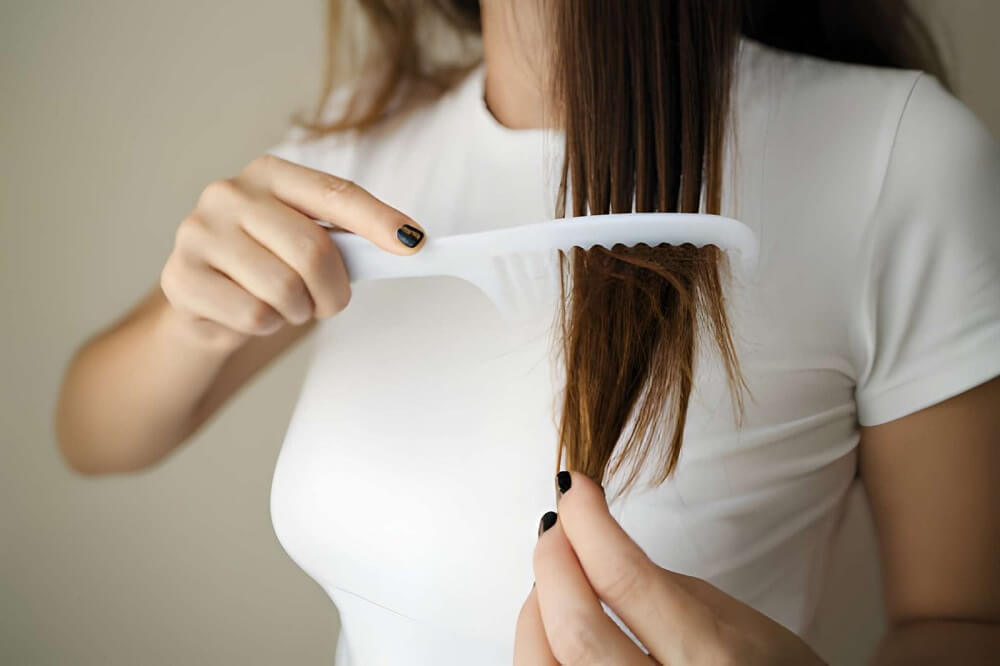
The landmark-pull method. This is the one I’d recommend to almost anyone, because it takes ten seconds and needs no tools. Pick a fixed reference point on your body — your earlobe, a mole on your neck, your collarbone. Gently pull a strand from a consistent spot (say, near your crown or hairline) and note where the tip lands relative to that landmark. Check again in 6 to 8 weeks, using the same strand location and the same pulling tension. If the tip now reaches noticeably past where it used to, that’s growth you can trust, without any measuring tape.
The ponytail or braid check. If your hair is long enough to tie back, this works well for tracking change over time with almost no effort. Note where your ponytail hits (a specific point on your neck or shoulder) or how far down a braid reaches, using the same hair tie tension and the same day-after-wash timing each check. This is more sensitive to overall length gain than people expect, and it’s something most readers are already doing anyway — you’re just paying attention to it deliberately instead of by accident.
The trim-and-track method (for the more patient reader). If you want more precision, snip a very small, deliberately marked section of hair at the scalp, note its length, and compare it again after 8 to 12 weeks. This is closer to how researchers track growth in small clinical studies. It’s more accurate than the landmark methods above, but it also takes real commitment, so I’d treat it as optional rather than the default recommendation.
Photo tracking, simplified. Whatever method you use, take a photo every few weeks under matching conditions: same time of day, same wetness, same lighting, hair combed flat. You’re not chasing a dramatic before-and-after. Small, consistent increments are what real growth actually looks like.
Whichever method you pick, checking daily is the wrong tool for the timescale you’re measuring. Give it weeks, not days.
4. The “New Baby Hairs” Myth
Scroll through any hair-growth forum and you’ll find people celebrating flyaways at their hairline as proof a treatment is working. I want to push back on this gently, because it’s one of the most common false positives I see.
Flyaways catching light differently at your part are often existing shorter hairs — vellus hairs, or strands mid-cycle at a shorter length — becoming visible under certain lighting or after certain styling. Not necessarily new. A genuinely new hair tends to start extremely fine at the tip, since it hasn’t been cut or damaged yet, and it’s noticeably shorter than the surrounding hairs of the same type.
The way to actually confirm a “baby hair” is new, rather than just newly visible, is to track it using one of the methods above. If that specific strand is measurably longer a month later, that’s confirmation. If it just seems more visible some days than others, that’s lighting, not growth.
5. What Your Fingers Know Before Your Eyes Do
Here’s something I don’t see covered much. Texture often signals new growth before your eyes can confirm it visually. New hair frequently feels finer, sometimes slightly different in curl pattern, compared to the more weathered, cuticle-worn hair around it.
Run your fingers gently along your part or hairline. Notice a texture shift near the scalp that gradually blends into your usual texture further down the strand? That’s often new growth in progress, well before it’s visible in a photo. It’s not a substitute for the measurement methods above — think of it as an early signal that tells you where to point your camera.
6. Growth vs. Breakage: The Distinction Most Articles Skip
This is, in my view, the single most important thing to get right, because “my hair isn’t growing” and “my hair is growing but breaking off just as fast” look identical from the mirror — and they call for completely different fixes.
| Signal | Points toward: Growth issue | Points toward: Breakage |
|---|---|---|
| Ends | Look intact, minimal fraying | Frayed, split, or visibly thinning at the tips |
| Styling habits | Minimal heat or chemical processing | Frequent heat styling, coloring, or chemical treatments |
| Landmark-pull test over 8+ weeks | No measurable length gain at the root section | Root section shows gain, but overall length stays flat |
| Shedding | Normal daily range (50–100 hairs) | Often normal — the loss is happening at the tip, not the root |
| Where hair “disappears” | Doesn’t seem to lengthen at all | Grows, then snaps off before it accumulates length |
| Typical next step | Investigate scalp health, nutrition, stress, or see a dermatologist | Focus on protective styling, reduce heat/chemical exposure, regular trims to stop split ends from traveling up the shaft |
If your ends look frayed and you’re styling heavily, breakage is the more likely explanation before you assume a growth-cycle problem. If your root sections are measurably not lengthening at all even with gentle handling, that points toward the follicle itself.
7. Why Age, Hair Type, and Season Quietly Change Your Baseline
Growth rate isn’t one fixed number, and comparing yourself to a generic online benchmark sets you up for disappointment over normal variation.
Hair type matters more than most people realize. A large study published in the European Journal of Dermatology measured hair growth across 2,249 young adults from 24 ethnic groups and found meaningful differences by ancestry — Asian hair grew fastest, Caucasian hair showed the highest overall density, and African hair grew more slowly on average, independent of the shrinkage-related visual illusion discussed earlier. Age plays a role too, with growth tending to slow gradually from the mid-30s onward as follicle activity shifts over time.
Season isn’t a myth either. A study of 823 women published in Dermatology found a clear annual pattern: telogen (resting-phase) hair peaked in summer, meaning more shedding tends to show up in late summer and early autumn, with the lowest rates in late winter. If you’re tracking your growth in October and comparing notes to a friend’s numbers from March, you may be comparing two different points in a normal seasonal cycle, not a real discrepancy in hair health.
None of this makes tracking pointless. It means the goal is your own baseline, not some universal number pulled from a forum post.
8. The Line Between Normal and Concerning
At what point does “I don’t see much growth” become “I should see someone about this”?
If you’ve tracked with a real method — not casual mirror-checking — for at least 12 weeks and measured genuinely no length increase, combined with visible thinning or shedding beyond the normal daily range, that’s a reasonable point to see a dermatologist. Sudden, patchy hair loss or a sharp jump in shedding compared to your own baseline are also signals that self-tracking has done its job and professional evaluation makes more sense than continuing to DIY it.
If your tracking shows normal small increments but it just doesn’t feel like enough, that’s usually a calibration problem, not a hair problem. Half an inch a month is objectively slow. It was always going to feel like very little happened.