

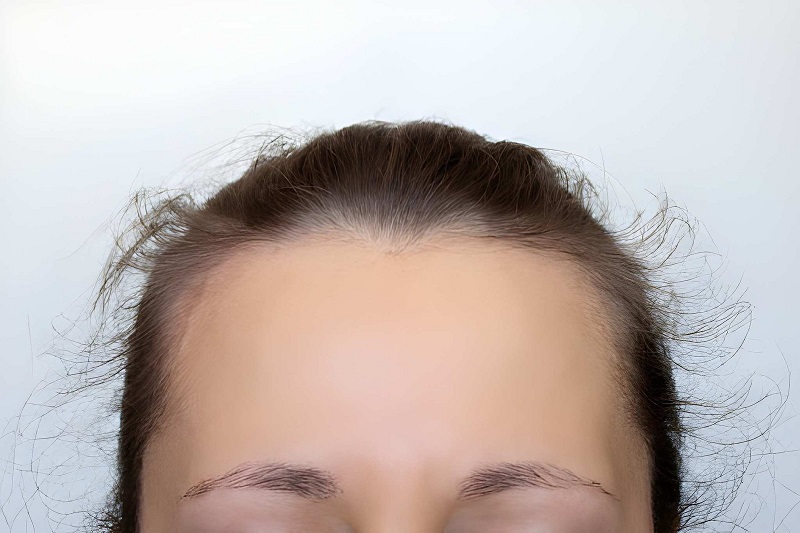
I get some version of this question constantly: “why won’t my baby hairs grow past an inch, I’ve tried everything.” And almost every time, the frustration comes from measuring the wrong thing.
Here’s the pattern I keep running into when readers describe their timeline. They’ll say they’ve used the same routine for six months, sometimes a year, and the hairline strands look identical to when they started. They assume something is broken. Usually nothing is.
Most people mentally benchmark hair growth against the number everyone quotes: about half an inch a month. That figure applies to terminal hair, the thick, pigmented strands making up most of your scalp. Baby hairs along the hairline are frequently vellus hair, a biologically different category with a shorter anagen (growth) phase built into the follicle itself. Shorter growth phase means a lower ceiling on length, full stop. No amount of patience changes that ceiling any more than patience changes someone’s adult height.
This is the piece almost no article on this topic states plainly, and it changes what “fixing” even means.
| Vellus Hair | Terminal Hair | |
|---|---|---|
| Shaft thickness | Very fine (under 0.03mm) | Thick (0.06mm+) |
| Pigment | Usually little to none | Fully pigmented |
| Anagen phase | Short (weeks to a few months) | Long (2-6+ years) |
| Lengthens over time? | Minimal, capped by follicle biology | Yes, until anagen ends |
If your baby hairs fall into this category, you’re not dealing with damage or deficiency. You’re dealing with follicle biology that was never built for length.
Four Different Situations Hiding Under One Search Term
Type “baby hairs not growing” into Google, or ask an AI assistant the same question, and you’ll get one blended answer that treats this as a single problem with a single explanation. That’s the misconception.
It’s actually four separate situations, and mixing them up is why so much advice online contradicts itself.
Genetic hairline vellus is the one I covered already, permanent by nature, purely cosmetic. But readers in my inbox also describe hairline regrowth that started after childbirth, which is a different mechanism entirely: telogen effluvium sheds a large batch of hair a few months postpartum, and what grows back initially looks like baby hairs simply because it’s starting fresh from a resting follicle. That’s temporary, and it resolves on its own timeline.
A third group is dealing with traction or heat damage, hairline breakage from tight styles, tension, or repeated heat exposure. This regrowth is real hair recovering, not a permanent feature, and it responds to changed behavior in a way genetic vellus never will.
The fourth, rarer situation is pili multigemini, a structural variant where multiple hair shafts emerge from a single follicle unit. Mechanically distinct from the other three, and it’s the one most likely to get mishandled by generic advice.
Before reading further, a quick check helps place yourself correctly:
Your category determines which advice below actually applies to you.
Why Plucking Pili Multigemini Backfires
Here’s the instinct almost everyone has with an odd hairline strand: pluck it and hope a normal one grows back. With pili multigemini, that instinct works against you. Since a natural pili multigemini follicle houses multiple shafts bundled into one unit, plucking doesn’t remove a single hair the way it would anywhere else on your scalp. It disturbs the whole shared follicle structure, which is exactly why readers report the same spot getting irritated, ingrown, or scarred after repeated plucking rather than improving.
The follicle doesn’t reset cleanly like a typical single-shaft hair does. Trauma to a multi-shaft unit tends to compound, not correct.
Do: trim the strands level with surrounding hair, leave the follicle alone, and see a dermatologist if the area becomes inflamed or keeps recurring.
Don’t: pluck, wax, or thread the area, since all three apply the same disruptive force to a structure that doesn’t tolerate it well.
The Deficiency Question, Answered Honestly
Search “baby hairs not growing” and you’ll land on a supplement ad within two clicks. Iron, zinc, biotin, vitamin D, protein, take your pick. The honest answer is messier than any ad wants to admit.
Deficiency only slows hair growth when you’re actually deficient, not simply below some optimal range. Someone with normal iron levels won’t grow baby hairs faster by adding more iron. That’s not opinion, it’s how nutrient-driven hair loss works: the deficiency causes the problem, so correcting it fixes that specific problem, and nothing more.
Here’s where the evidence actually stands for each one:
| Nutrient | Claimed Effect | Evidence Strength | Helps Without Diagnosed Deficiency? |
|---|---|---|---|
| Iron | Supports growth phase | Strong (if deficient) | No |
| Zinc | Follicle function | Plausible (if deficient) | No |
| Biotin | Hair growth booster | Weak | Rarely, unless deficient |
| Vitamin D | Follicle cycling | Conditional | Unclear |
| Protein | Structural building block | Strong (if intake is low) | No, if intake is already adequate |
So if your baby hairs aren’t growing and your diet is already reasonable, a blood test tells you more than a bottle of biotin gummies ever will. Supplementing without a known deficiency mostly buys peace of mind, not results.
What Timeline to Actually Expect, By Category
The question I get right after someone tells me their baby hairs aren’t growing is always the same: okay, so how long until they do. Most articles dodge this with something like “everyone’s different,” which is true and also useless.
Here’s the thing: your timeline depends entirely on which category from earlier you’re actually in, not on trying harder or waiting longer in general. Postpartum regrowth follows a fairly predictable hormonal curve, since the shedding that triggered it was hormone-driven in the first place. Traction damage has no fixed endpoint at all, because the timeline is tied to your behavior, not a biological clock. Genetic vellus hair isn’t on a timeline in the way people hope, since there’s no future date where baby hairs that fall into this category start lengthening.
| Category | Expected Timeline | What Actually Changes It |
|---|---|---|
| Postpartum regrowth | Roughly 6–12 months | Hormones stabilizing on their own |
| Traction/heat damage | No fixed timeline, ongoing | Stopping the tension or heat causing it |
| Genetic hairline vellus | None, doesn’t lengthen | Nothing, it’s follicle biology |
| Pili multigemini | Not growth-related | N/A, it’s a structural variant |
If you’re six months into “fixing” baby hairs that aren’t growing and you fall into the genetic category, the timeline was never the problem. The expectation was.
What Helps (And What Doesn’t) Per Category
By this point the mistake is obvious in hindsight: one routine can’t fix four different situations, yet that’s exactly what most hairline serums promise to readers dealing with baby hairs not growing.
If you’re dealing with traction or heat damage, the fix isn’t a product at all. It’s reducing tension styling and heat exposure, since the regrowth responds to removing the cause, not adding something on top of it. Biotin or “growth serums” here mostly delay the realization that the styling habit, not some hidden growth blocker, is the actual problem.
Postpartum regrowth needs less intervention than people expect. Gentle scalp care and time cover most of it, since the shedding was hormonally triggered and resolves the same way. Aggressive treatments or heavy product layering can irritate a scalp that’s already going through a natural cycle, without speeding anything up or making baby hairs grow any faster than biology allows.
Genetic hairline vellus is the one category where a topical option exists, though I’d call it conditional rather than promising. Minoxidil has some evidence for stimulating vellus follicles in certain readers, but results vary and it requires ongoing use to maintain. What doesn’t help here, ever, is plucking or waxing those strands, which only irritates a follicle that was never going to lengthen regardless of how patient you are.
So if your baby hairs aren’t growing no matter what you try, the honest fix depends on which of these four categories you’re actually in, not on finding a stronger product.
When It’s Not Baby Hairs At All
Everything above assumes the strands you’re looking at actually are baby hairs. Sometimes they’re not, and that’s the differential nobody wants to consider, because it points somewhere less reassuring than genetics or postpartum timing.
Early androgenetic hair loss can mimic baby hairs early on, since miniaturizing terminal hair shrinks down and starts looking exactly like the fine, short strands we’ve been discussing. The difference isn’t texture, it’s pattern and trajectory.
A quick differential checklist:
If you’re answering yes to spreading pattern, family history, or visibility change, this stops being a baby hair question. That’s worth a dermatologist visit rather than more guessing, since early intervention matters more for pattern hair loss than it does for any of the categories covered here.
For readers who suspect thinning is the real story rather than baby hairs specifically, I’ve gone deeper into why the question itself is misleading in a separate piece, which is worth reading before assuming either explanation.