

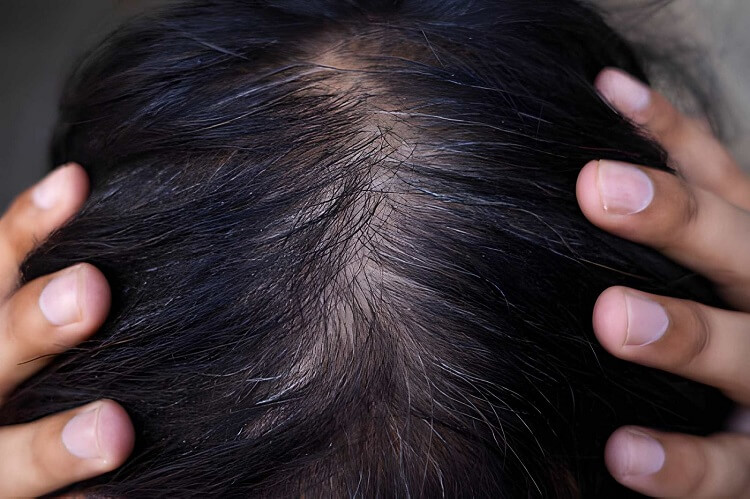
Two Reddit posts about hair crown thinning, months apart, showed almost the same photo: a man in his mid-twenties, camera angled down at his crown, hair visibly thinner than it used to be.
The top comment on the first thread was reassuring. “Normal, genetics, everyone’s crown does this eventually.”
The top comment on the second thread went a different direction. Someone pointed out the poster’s scalp looked red and irritated in the photo, and the conversation shifted toward thyroid issues and deficiencies rather than balding.
Same symptom. Same rough age. Two completely different verdicts from two different crowds of strangers.
That contradiction stuck with me longer than it probably should have. Something is missing from how crown thinning usually gets explained, if two nearly identical-looking posts can get opposite diagnoses from anonymous commenters.
So I went back through both threads more carefully, then into the clinical literature, trying to figure out what the disagreement was actually about. It wasn’t the thinning itself. It was what surrounded it.
The calm threads described a slow, even fade with nothing else going on. The concerned threads had a second detail attached — irritation, flaking, or a defined edge instead of a general thinning.
That distinction turned out to matter more than I expected. It’s the thread this entire article follows.
Why Hair Crown Thinning Isn’t One Condition
Crown thinning has at least three visually distinct patterns, and each one points toward a different underlying cause. Most articles on this topic treat crown thinning as a single problem, which is exactly what left those two Reddit threads talking past each other.
The most common cause is genetic, driven by androgenetic alopecia and the hormone DHT. It isn’t the only cause, though, and it isn’t always the correct one for a given case.
Telogen effluvium, a stress-related shedding condition, produces sudden diffuse thinning with no defined edge. Inflammatory scalp conditions like seborrheic dermatitis add redness, flaking, or tenderness to the picture. And a cause almost nobody talks about — mechanical thinning from friction and styling tension — can concentrate hair loss at the exact point where a pillow or a hair tie makes repeated contact.
Here’s what surprised me most while researching this. Every major hair-loss resource I checked jumps straight to DHT and follicle miniaturization. That’s a reasonable default, since it is the most common cause, but presenting it as the only explanation is why threads full of confused twenty-somethings keep circling the same unresolved question.
The Crown Thinning Self-Check
Diffuse vs. Defined vs. Mechanical Thinning
The shape and edges of your thinning tell you more than the fact that it’s happening at all. A diffuse, evenly graduated fade across the crown points toward a hormonal or genetic process. A defined patch with a sharper edge, especially with any redness or scaling, points toward inflammation or a scarring process, which needs a dermatologist’s eyes on it rather than a self-diagnosis.
A pattern that’s noticeably worse exactly where your hair gets rubbed at night or pulled during styling, and roughly normal elsewhere, points toward a mechanical contribution rather than a purely hormonal one.
None of this replaces a professional evaluation. It’s a starting point for narrowing down what to look into first.
Crown Thinning Self-Check
Thinning is gradual and even across the crown → consistent with an androgenetic pattern
Thinning appeared over a few weeks with no defined edge → consistent with telogen effluvium
Scalp is red, flaky, itchy, or tender at the site → consistent with an inflammatory cause; see a doctor
Thinning is concentrated exactly where hair contacts a pillow or gets pulled during styling → consistent with a mechanical contribution
Accompanied by fatigue, weight change, or mood shifts → possible hormonal or thyroid involvement; medical evaluation warranted
Androgenetic Crown Thinning — The Most Common Pattern
How DHT Targets the Crown Specifically
The crown carries a higher density of androgen receptors than many other areas of the scalp, which is a large part of why genetic thinning tends to show up there first. DHT binds to these receptors and gradually shortens the hair follicle’s growth phase.
This has been demonstrated directly in animal research. In one laboratory model of androgenetic alopecia, DHT inhibited hair regrowth and miniaturized hair follicles, alongside measurable hair density loss and altered hair morphology. The clinical picture in humans follows similar logic: research on androgenetic alopecia consistently points to genetically determined follicle sensitivity to DHT, not circulating hormone level alone, as the key driver.
That’s why two men with similar DHT levels can show very different amounts of crown thinning. Genetic susceptibility is the prerequisite; DHT alone isn’t sufficient without it.
What Follicle Miniaturization Actually Looks Like Over Time
Miniaturization isn’t hair falling out and never returning. Each growth cycle produces a slightly finer, shorter, less pigmented hair than the one before it, until what’s left is closer to peach fuzz than terminal hair.
This is why crown thinning often gets dismissed early. The strands are still there, just progressively weaker. I’ve written about what this cycle looks like at the follicle level in more detail in The Hair Growth Cycle Stages.
One correction worth making: crown thinning is frequently one of the earliest signs of androgenetic alopecia, not a late-stage one. Waiting until it looks “bad enough to worry about” usually means waiting through the window where intervention works best.
When Crown Thinning Isn’t Genetic
Stress-Related Shedding (Telogen Effluvium)
Not all crown thinning is permanent. Telogen effluvium is triggered by a stressor — illness, surgery, rapid weight loss, or major emotional strain — that pushes a large share of hairs out of the growth phase at once.
The timeline is fairly predictable. Shedding typically begins three to four months after the triggering event, hair loss usually takes another three to six months to fully cease, and regrowth becomes noticeable within a further three to six months, according to a clinical review of telogen effluvium. As Mayo Clinic explains, significant stress pushes large numbers of hair follicles into a resting phase, and the affected hairs can fall out suddenly during ordinary combing or washing.
If your crown thinning started suddenly, a few months after a rough physical or emotional stretch, and there’s no defined bald patch, this is worth considering before assuming it’s genetic.
Inflammatory Scalp Conditions and Red-Flag Signs
Redness, flaking, tenderness, or scaling at the site of thinning changes the picture. Conditions like seborrheic dermatitis or scalp psoriasis cause inflammation that can damage follicles directly, and in rarer cases, scarring alopecia can cause permanent loss if left untreated.
This is exactly the detail that shifted the second Reddit thread’s advice away from “normal balding,” and it was the right instinct. A dermatologist can confirm what’s happening far more reliably than a symptom checklist if you’re seeing any of these signs. I’ve gone deeper into distinguishing flaking-related scalp issues in Scalp Psoriasis vs. Dandruff.
The Overlooked Cause — Mechanical Crown Thinning
Constant friction or tension concentrated at one point on the scalp can thin hair there without any hormonal involvement at all. This is essentially traction alopecia. It’s usually discussed in the context of the hairline, but the same mechanism applies wherever repeated tension is concentrated, including the crown, if that’s where a pillow or a hair tie makes the most contact.
I found this angle in an unexpected place: a comment buried in r/Naturalhair, describing a crown that felt “less dense” than the rest of the scalp, attributed to nightly friction and styling tension.
The clinical literature backs this up as a distinct, non-genetic mechanism. According to NCBI’s StatPearls overview of traction alopecia, the condition arises from repeated tension on the hair roots, causing mechanical damage to the hair follicle and dermal papilla, the structures responsible for producing new hair. It’s unique among forms of hair loss in being initially reversible, before becoming a permanent, scarring form if the tension continues unaddressed.
That reversibility window is the reason this cause deserves more attention than it gets. A looser hairstyle, a satin pillowcase, or less tension during styling can meaningfully change the trajectory, but only if it’s identified before the damage becomes chronic.
Crown Thinning Expectations vs. Reality
What you can realistically expect depends heavily on which pattern of crown thinning you’re dealing with. The honest answer is less dramatic than most marketing copy suggests.
| Cause | Expectation | Realistic Timeline |
|---|---|---|
| Androgenetic (genetic) | Slows or stabilizes with treatment; full reversal is uncommon | 4–12 months to see measurable change |
| Telogen effluvium | Often fully reversible once the trigger resolves | 3–6 months to stop, 3–6 more to regrow |
| Inflammatory/scalp condition | Reversible once the underlying condition is treated | Varies; requires a diagnosis first |
| Mechanical/friction | Reversible if the mechanical stressor is removed early | 2–4 months, longer if damage is advanced |
Minoxidil and finasteride are the two options with the strongest evidence base for the genetic form, but neither works quickly. Both require several months of consistent use before density changes become visible.
Frequently Asked Questions
Can thinning hair on the crown grow back?
It depends on the cause. Telogen effluvium and early-stage mechanical thinning are often fully reversible once the trigger is removed, while genetic androgenetic alopecia can usually be slowed or partially improved with treatment but rarely fully reversed.
How do you fix thinning hair at the crown?
The right approach depends on identifying the cause first. A self-check for pattern — diffuse, defined, or friction-localized — combined with any accompanying symptoms narrows this down. From there, options range from minoxidil for genetic thinning, to simply removing a stressor for telogen effluvium, to reducing styling tension for mechanical cases.
What is Stage 4 crown hair loss?
This refers to a stage on the Norwood-Hamilton scale, a grading system dermatologists use to classify the progression of male pattern baldness from stage I (minimal) to stage VII (extensive). At stage 4, frontal hairline recession becomes more pronounced and vertex thinning appears clearly, but the two areas are still separated by a visible band of hair. They don’t fully connect until later stages of the scale.
Will I go bald if my crown is thinning?
Not necessarily. It depends on the cause and, for genetic cases, on family history and rate of progression. Crown thinning from telogen effluvium or mechanical friction is often reversible, while genetic thinning tends to be progressive without treatment, though it can usually be slowed significantly with early, consistent intervention.
What the Pattern Actually Told Me
Looking back at those two Reddit threads, both sets of commenters were partially right. They just weren’t describing the same condition. One thread had a straightforward genetic pattern; the other had a red flag that genuinely warranted a closer look.
That’s the core of what crown thinning research keeps circling back to: the pattern of thinning is more informative than the fact of thinning itself. Running your own self-check before choosing a treatment path saves both time and money spent chasing the wrong cause.
None of this substitutes for a dermatologist’s evaluation, especially if you’re seeing redness, scarring, or rapid progression. But it’s a far better starting point than assuming every case of crown thinning is the same story.