
A reader wrote to me a while back. Frustrated.
Her scalp scrub had basically stopped working. Not “hadn’t worked from the start.” Stopped. She’d been using it for months, flaking under control, and then it crept back.
Her fix was to scrub more often.
It got worse.
That detail stuck with me. Most people assume if a little exfoliation helps, more should help faster. It’s the same logic we apply to skincare, to cleaning, to almost everything we scrub or scour.
Scalps don’t seem to work that way.
So what are the real scalp scrub benefits, and where’s the line where they stop applying? That’s the question worth answering. Not another list of six generic perks you’ve already read on five other sites.
This is about the mechanism underneath those benefits. Why it works for some people. Why it quietly backfires for others. And where that dose-response curve actually bends.
Her story runs through the rest of this piece. It answers more than it first seems to.
Do Scalp Scrubs Work the Same Way as Shampoo?
Short answer: no. And that surprises more people than you’d expect.
Shampoo is designed to lift oil and residue off hair strands, mostly through surfactants that bind to grease and rinse away. It touches the scalp, sure. But touching isn’t the same as exfoliating.
Here’s the part most people miss. Skin sheds cells constantly, all over the body, including the scalp. Normally that shedding is invisible. But mix dead skin cells with sebum and leftover product, and you get a kind of paste that settles into the spaces around hair follicles — the exact pattern I break down in do you have scalp buildup. Shampoo’s surfactants aren’t built to physically dislodge that. They’re built to dissolve oil, not scrape off compacted skin cells — which is a distinction dermatology sources back up when they talk about scalp buildup separately from hair cleansing.
That’s the actual job a scrub does. Physical grains, or a chemical exfoliant like salicylic acid, break up that buildup mechanically or chemically instead of just rinsing surface oil.
I’ve seen the “but shampoo already exfoliates” claim come up constantly in scalp forums, usually stated with total confidence. It’s one of those things that sounds true because shampoo feels thorough. Foam, lather, a good scrub with fingertips. It feels like enough.
It often isn’t. Shampoo isn’t failing at anything here. It was just never built for this particular job.
That distinction matters more than it seems. Once you understand what a scrub is actually removing, the benefits people report start making a lot more sense. So does the point where those benefits stop.
The Real Scalp Scrub Benefits, Graded Honestly
When people ask about the benefits of a scalp scrub, they’re usually really asking which claims are actually true — and not every claimed benefit deserves equal trust. Some hold up well. Others are repeated so often they start to sound proven, even when the evidence is thin.
Here’s how I’d actually grade them, based on how the research and reader-reported patterns line up, not a formal clinical scale.
| Claimed Benefit | Evidence Strength | What’s Actually Happening |
|---|---|---|
| Reduces flaking/dandruff | Moderate-strong | Removes buildup that mimics or worsens flaking |
| Supports hair growth | Weak-indirect | Clears follicle blockage; doesn’t grow hair directly |
| Boosts circulation | Weak | Massage motion, not the scrub itself, likely responsible |
| Balances oil production | Moderate | Short-term sebum reduction, not permanent “rebalancing” |
| Improves product absorption | Moderate | Plausible, but understudied specifically for the scalp |
| “Detoxifies” scalp | Not supported | Marketing term, not a real physiological process |
The flaking reduction is probably the strongest of the scalp scrub benefits, and it makes sense given what we covered above. If buildup is contributing to visible flakes, removing that buildup should reduce them. That’s straightforward cause and effect.
Hair growth is where things get shaky. A blocked follicle environment isn’t ideal, that part’s reasonable. But “clearer follicles” and “more hair growth” aren’t the same claim, and treating them as interchangeable is where a lot of marketing overreaches.
Circulation gets credited to the scrub a lot. I’d push back on that slightly. The massaging motion your fingers or a brush make is more likely responsible for any circulation increase than the exfoliating particles themselves.
Then there’s “detox.” I’ll be blunt: this word does a lot of work it hasn’t earned. Skin doesn’t accumulate toxins that need extracting through scrubbing. What it accumulates is oil, dead cells, and product, which is a cleaning problem, not a detox problem.
Worth mentioning here: I’ve seen people on Reddit describe paying for salon scalp detox treatments and walking away unconvinced, saying regular shampooing did the same job for a fraction of the price. That tracks with what I found when I went deeper into scalp detox benefits specifically — the mechanical case holds up, the marketing language around it doesn’t. The scalp scrub benefits that hold up are the mechanical ones. The ones dressed up in spa language tend to be the ones that don’t.
When Scrubbing Backfires
Back to that reader.
She’d scaled up her scrubbing to fight the flaking. It didn’t help. It made things worse, and she couldn’t understand why doing more of a thing that had worked would suddenly stop working.
Here’s what I think was actually happening. Skin has a barrier layer, a mix of lipids and cells that keeps moisture in and irritants out. Scrub too often, or too aggressively, and that barrier gets compromised. The skin responds the way irritated skin usually does: it flakes.
So she looked at her own flaking and reasonably concluded she needed more exfoliation. But this new flaking wasn’t buildup anymore. It was irritation dermatitis, dressed up as the exact symptom she was trying to treat, and the overlap is real: the AAD describes dandruff as essentially a milder, uninflamed version of the same underlying condition, which is part of why the two get confused so easily.
This is the part I think gets missed almost everywhere. Buildup-flaking and irritation-flaking look nearly identical from the outside, the same ambiguity I dig into in scalp psoriasis vs dandruff. Same visual result, opposite underlying cause, and opposite correct response. One calls for more exfoliation. The other calls for backing off entirely and calming the skin down.
You can’t tell them apart just by looking at flakes on a dark shirt. That’s the honest limitation here, and no amount of confident blog advice changes it.
What actually helped her, eventually, was pulling back to once a week and adding something calming instead of something abrasive. The flaking cleared in about three weeks.
Not because she found a better scrub. Because she stopped treating a skin-barrier problem like a buildup problem.
Worth saying plainly: if flaking sticks around after you’ve backed off and calmed things down, or if it comes with real pain, spreading redness, or hair loss, that’s outside what any scrub can fix. That’s a dermatologist visit, not a routine adjustment.
That distinction, more than any product recommendation, is probably the most useful thing in this entire article.
Does Scalp Type Change the Calculus?
Yes, and this is where blanket advice tends to fall apart.
An oily scalp produces more sebum, which means more raw material for that buildup paste to form. These scalps usually tolerate exfoliation better and often benefit from it more consistently, since there’s genuinely more to remove.
Dry scalps are trickier. Less oil doesn’t mean less flaking, sometimes it means the opposite, because the flaking is coming from dehydration rather than buildup. Scrub a dry scalp the same way you’d scrub an oily one, and you’re not clearing anything useful. You’re just adding friction to skin that’s already struggling to hold onto moisture.
Sensitive scalps need the most caution. Redness, tightness, a history of reacting to new products. These are the scalps most likely to end up in the same barrier-disruption situation my reader hit, and often at a lower threshold than most people expect.
None of this fits neatly into “scrub twice a week” advice. I’d argue that kind of universal number is part of the problem, not a solution. It assumes every scalp starts from the same place.
A better approach: start with what your scalp actually does, oily, dry, reactive, and let that shape the frequency and product choice from there. If you’re not sure which one you’re dealing with, how to determine your scalp type is worth five minutes before you buy anything. Not the other way around.
Physical vs. Chemical Exfoliants
Two different tools, doing the job two different ways.
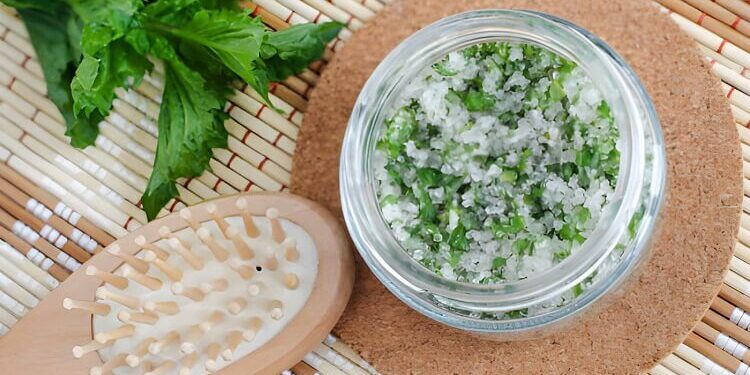
Physical scrubs, sugar, salt, jojoba beads, work through friction. Grains break up buildup as you massage them in. Straightforward, and easy to feel working in real time.
Chemical exfoliants like salicylic acid work differently. Cleveland Clinic describes salicylic acid shampoo as working by breaking down layers of thick, built-up skin on the scalp, loosening the bonds holding dead cells together so buildup releases on its own rather than being scraped off. No grit involved.
For dandruff specifically, salicylic acid tends to have a slight edge, since it can get into areas a physical scrub might skip over. For general buildup and that satisfying “clean scalp” feeling, physical scrubs usually win.
Then there’s the brush question, which comes up constantly. Scalp scrub brush benefits are mostly about consistency and reach. Fingers are inconsistent, some areas get more pressure than others without you noticing. A brush distributes pressure more evenly and reaches the crown and back of the head more easily than fingertips alone.
Neither tool is inherently better. It depends on what you’re actually trying to solve.
How Often, Realistically
I’m not going to give you a number and pretend it applies to everyone. That’s the exact mistake my reader’s routine ran into.
A more honest framework looks like this: start once a week, the same baseline I walk through step by step in scalp exfoliation at home. Watch what happens over the next couple washes, not just the next one. Skin takes time to show irritation, so judging after a single session tells you very little.
If things improve, stay there. If nothing changes after a few weeks, you can experiment with twice a week. But watch closely, because the signals that you’ve gone too far often look deceptively similar to the problem you started with.
Signs you’re overdoing it:
- Increased flaking after scrubbing more, not less
- Tightness or stinging during or after washing
- Redness that wasn’t there before
- Hair feeling more prone to breakage near the scalp
- Needing to scrub more frequently just to get the same relief
That last one is the trap my reader fell into. Needing more to get the same result usually isn’t a sign to push harder. It’s usually a sign to stop and let things settle.
Frequency isn’t a fixed rule here. It’s a feedback loop.
Coffee Scrubs and Other Variants
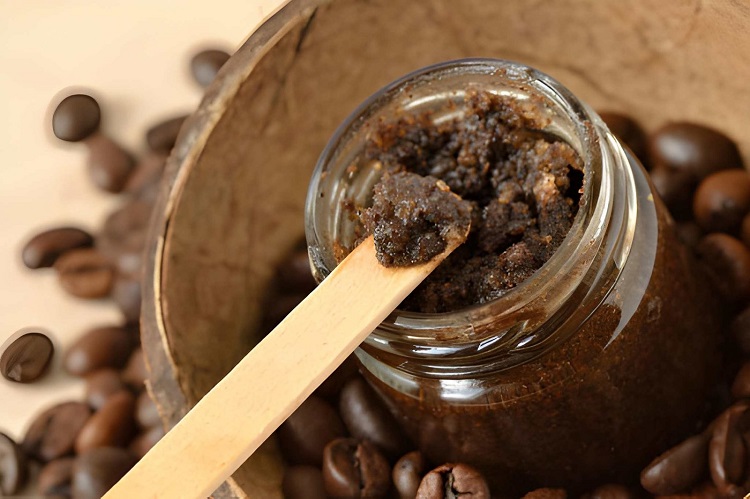
Coffee scalp scrub benefits get talked about a lot, usually with caffeine positioned as some kind of growth-boosting ingredient.
The actual evidence is thinner than the marketing suggests. A systematic review of clinical trials on topical caffeine for hair loss found only nine trials met real inclusion criteria out of more than a thousand screened, and much of the strongest effect data comes from lab-cultured follicles, not real-world scalps. Some of the caffeine research comes from controlled lab conditions — cells or follicles exposed directly, for far longer than a two-minute rinse-and-go scrub allows. A quick scrub-and-rinse isn’t really replicating those conditions, though. You’re not leaving it on long enough for that mechanism to plausibly matter.
What coffee grounds are reliably good at is exfoliating, the grain size works well for physical buildup removal. That part’s real. The follicle-stimulating angle is mostly borrowed credibility from a different kind of study entirely.
Same logic applies to most trendy variants, charcoal, sea salt, whatever’s popular this year. The exfoliating mechanism is usually legitimate. The bonus claims layered on top are usually where things get exaggerated.
Key Takeaways
The Line, Not the Verdict
My reader’s scalp settled after she stopped trying to out-scrub the problem. Once a week. Something calming instead of something abrasive. Three weeks, and the flaking that had been getting worse for months finally leveled off.
Nothing about scrubbing changed in that story. Only the amount did.
That’s really the whole point here. The same mechanical action that clears buildup is the one that irritates skin when it’s overdone. Same tool, same motion, opposite outcome depending on where you land on that line.
So the real question was never scrub or don’t scrub. It’s how much, for the scalp you actually have. Everything else in this article was just working out where that line tends to sit.