

Table of Contents
Those are the quick answers. But “often” and “usually” are doing a lot of work in them, and the only way to know which side of that word you’re on is to look at an actual case.
A woman messaged me a while back. Could her edges actually grow back, or had two years of near-constant knotless braids already made that decision for her?
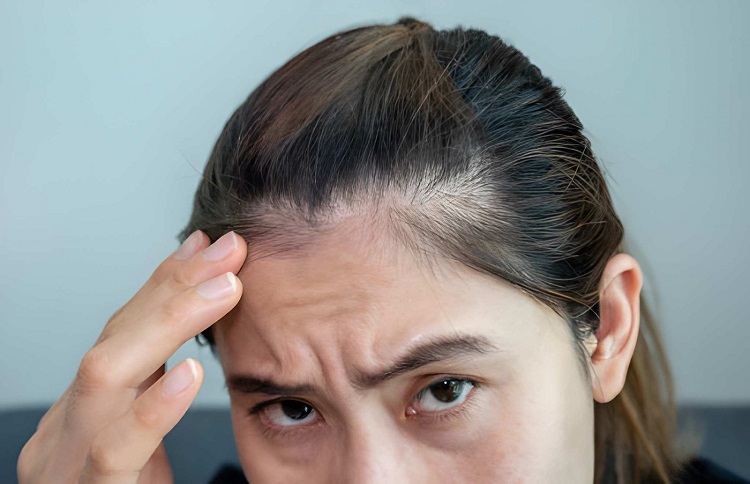
She sent a photo. Smooth skin ran about an inch back from where her hairline used to sit, on both sides.
That gap, between “thinning” and “gone,” is where most advice on this topic falls apart. Avoid tight styles. Try castor oil. Fine advice, if every case of edge loss started from the same point. Hers didn’t.
If your edges look worse than a stack of Reddit tips has managed to fix, yours probably doesn’t either.
Here’s what actually decides whether edges grow back. Not the product. Not how much castor oil you’ve gone through. It’s whether the follicle underneath that thinned strip is still alive under there, or whether it’s scarred over. That one distinction gets skipped almost everywhere this question gets answered.
I’m not a dermatologist. I read the research, I read what people are actually going through, and I try to figure out what the evidence really supports instead of what sounds good on a label.
Her case is where I want to start. It taught me more about this topic than any single study did.
1 Why “grow edges back” isn’t one problem
Here’s something I didn’t expect when I started digging into this: edges aren’t more fragile because they’re weaker hair. They’re more fragile because they run on a shorter clock.
Every follicle cycles through growth, rest, and shedding. The ones along your hairline tend to spend less time in that active growth phase than the hair further back. Less growth time, less buffer.
A few months of tight braids can wipe that buffer out completely. That’s part of why edges vanish faster than hair loss shows up anywhere else on the head.
But a short cycle cuts both ways. The same follicle that gives up hair quickly under stress can start producing again fairly quickly once the stress is gone, provided it hasn’t been pushed past that point. This is the piece most articles skip. They treat thin edges as one fixed outcome, you either have them or you don’t, when what’s really happening looks more like a spectrum with a hard stop at one end.
That hard stop is scarring. Before it, a follicle might just be producing thin, short vellus hairs instead of thicker terminal hair, a sign of stress, not death. After it, there’s no follicle left to regrow anything.
Most people trying to regrow edges sit somewhere in the middle of that spectrum. Not at either extreme. Figuring out where matters more than any product you’re about to buy.
2 The self-check nobody puts first: reversible or scarred
So I asked her the same question I’d ask anyone in this situation: run your fingers along the thinned strip and look closely. Is there stubble there, short broken hairs, or is the skin completely smooth?
She wrote back that there was some stubble near the front. Less toward the temples, almost none.
That answer told me more than her two years of styling history did. Stubble means the follicles are still alive down there, still trying. Smooth, shiny skin usually means they’ve been replaced by scar tissue, and scar tissue doesn’t grow hair no matter what you put on it.
This is the check I wish every article on this topic led with instead of a product list. It costs nothing, takes about a minute, and it’s the single best predictor of whether your specific edges are going to respond to anything at all.
Is Your Edge Regrowth Still Reversible? Run Through This:
Most people who go through this list don’t check every box. They check two, maybe three. And that’s fine, it’s not a pass-fail test.
Meeting most of these points toward a genuinely good chance of recovery once the tension stops. Meeting only one or two, especially if the skin is smooth and the thinning has been there for years, points toward something a dermatologist needs to look at, not something an oil is going to fix. The honest answer for most readers sits somewhere in between, which is exactly why “it depends” isn’t a dodge here. It’s the actual answer, and the checklist is how you figure out which side of it you’re on.
3 What’s Actually Causing Your Edges to Thin
The checklist tells you where you sit on the reversible-to-scarred spectrum. It doesn’t tell you why you’re there in the first place, and that’s a different question.
Traction gets most of the attention in edge-thinning discussions, and for good reason, it’s the most common cause. But it’s not the only one, and lumping every case under “traction alopecia” is how people miss what’s actually happening to them.
Here’s how the main causes compare on pattern, reversibility, and realistic timeline:
| Cause | Thinning pattern | Reversible? | Typical timeline if addressed |
|---|---|---|---|
| Traction alopecia (early) | Uneven, hairline/temples | Usually yes | 8–12 weeks to early regrowth |
| Traction alopecia (late/scarred) | Smooth, shiny skin | Rarely without medical help | Often permanent |
| Postpartum shedding | Diffuse, often includes edges | Usually yes, self-resolving | 3–6 months |
| Hormonal (thyroid, etc.) | Diffuse, edges + crown | Yes, if condition treated | Varies with treatment |
| Genetic/pattern thinning | Gradual, edges + part line | Not without ongoing treatment | N/A without intervention |
| Frontal fibrosing alopecia | Receding band, scarring | No | N/A |
One pairing in that table deserves more attention than it usually gets: late-stage traction alopecia and frontal fibrosing alopecia look almost identical in women over 40, and I mean that literally, not as a figure of speech. Both produce a smooth, receding band along the hairline. Both can show scarring. The styling history is what tells them apart, and it’s often the one detail nobody asks about.
Someone with decades of tight styles who develops a scarred hairline in her 40s or 50s could reasonably assume it’s traction catching up with her. Sometimes it is. But FFA tends to show up around the same age, unrelated to styling, and it’s frequently misread as “just” traction because the visual overlap is so close. Getting that distinction wrong doesn’t just waste time on the wrong fix. It can mean months spent avoiding tight styles while an unrelated condition keeps progressing underneath.
4 What’s worth trying, graded honestly
Once someone knows roughly where they sit on that spectrum, the next question is always the same. Fine, but what do I actually put on it?
Here’s my honest read, ingredient by ingredient, graded by what the evidence actually shows rather than what the bottle claims.
Castor oil, including the Jamaican black castor oil version everyone recommends, is genuinely useful for one thing: it seals moisture and reduces breakage on hair that’s already there. That matters, because less breakage means less visible thinning day to day. What it doesn’t have is real evidence of stimulating new follicle activity. The “growth” a lot of people report is very likely reduced breakage plus reduced handling, since oiled hair gets touched and restyled less.
Rosemary oil has slightly more going for it. Small studies have compared it to low-dose minoxidil for general hair growth with reasonably similar results. None of those studies looked specifically at edges or traction-related thinning, so treat this as promising, not proven for your exact situation.
Aloe vera and shea butter are scalp-comfort ingredients, not growth ingredients. They calm irritation and lock in moisture. Useful if your scalp is inflamed or dry, irrelevant to whether a follicle starts producing hair again.
This is usually the point where “how to grow edges back” searches lead people to minoxidil, and it’s the only option on this list with actual clinical trial data behind it for hair regrowth generally. It won’t fix a scarred follicle. On an intact one, it has real backing.
Here’s where I’ll say something plainly instead of hedging it: most edge-specific products lean on the ingredient story, castor oil “feeds growth,” rosemary “awakens follicles,” language that oversells what’s in the bottle. The actual mechanism behind most reported improvement is simpler and less marketable. People buy a product, start handling their edges more gently because they’re “treating” them, stop the tight styles that caused the problem, and the reduced tension does the real work. The oil gets the credit.
That’s not a reason to skip these products. It’s a reason to stop expecting the oil to do a follicle’s job.
5 The caution nobody mentions: minoxidil that close to your face
There’s a practical problem with minoxidil at the hairline. Almost nobody brings it up. It’s not about whether it works. It’s about where else it can end up.
Minoxidil doesn’t stay exactly where you put it. Apply it right along the hairline, especially in liquid or foam form, and it can migrate onto skin it was never meant to touch: your forehead, your brows, sometimes the upper lip. On facial skin, that same growth-stimulating effect can show up as fine unwanted hair in places you weren’t trying to treat.
This isn’t a reason to skip minoxidil if your edges are still reversible. It’s a reason to apply it carefully.
A cotton swab or a fine-tip applicator gives you far more control than fingers or a spray nozzle ever will. Apply to dry skin. Let it fully absorb before touching your face or lying down. Keep it slightly back from the actual edge of your hairline instead of right at the border.
None of the top-ranking articles mention this. I think that’s a real gap. Someone already self-conscious about a thinning hairline doesn’t need a new problem showing up on their forehead because of how the product was applied.
6 Realistic timelines by cause
Back to the woman who messaged me at the start of this. She stopped the tight braid cycle, not permanently, just long enough to see what would happen on its own.
Ten weeks later, the front section of her hairline, the part with visible stubble when she first checked, had noticeably filled back in. Her temples, the smoother patch with almost no stubble, hadn’t moved at all.
That gap between the two areas isn’t a coincidence. It’s the stage-based framework from earlier playing out in real time, on the same head, under the same conditions. Same person, same styling changes, two completely different outcomes depending on what was actually happening at the follicle level before she even started.
This is why a single timeline for “how long until edges grow back” was never going to be honest. Early traction thinning, the kind with stubble still present, tends to show real movement in that 8 to 12 week range once tension stops. Postpartum shedding often resolves on a slower, 3 to 6 month curve without any intervention at all. Genetic thinning doesn’t really have a timeline in the same sense, not without ongoing treatment to maintain whatever regrowth happens.
Her case is a small sample, one person, not a study. But it’s a clean illustration of something the research backs up: the stage you’re starting from decides the timeline far more than anything you apply to it.
7 When to stop DIY and see someone
At some point, DIY stops being the responsible option, and it’s worth knowing where that point actually is instead of guessing.
Eight to twelve weeks of consistently low-tension styling with no visible change, no stubble, no softening of the smooth patch, is a reasonable line. Not a failure on your part. Just a signal that whatever’s happening isn’t responding to tension removal alone, which means something else is likely driving it.
Redness, scaling, or persistent bumps along the hairline are worth mentioning to a doctor regardless of timeline. Those can point to scalp conditions that no amount of oil or patience will resolve on their own.
A strong family history of female pattern hair loss changes the calculation too. It doesn’t mean edges definitely won’t recover, but it does mean genetics may be doing more of the work than styling habits, and that’s a conversation worth having with a dermatologist rather than a comment section.
None of this is meant to rush anyone into an appointment out of fear. It’s meant to save you from spending another six months on a routine that was never going to touch the actual cause.