

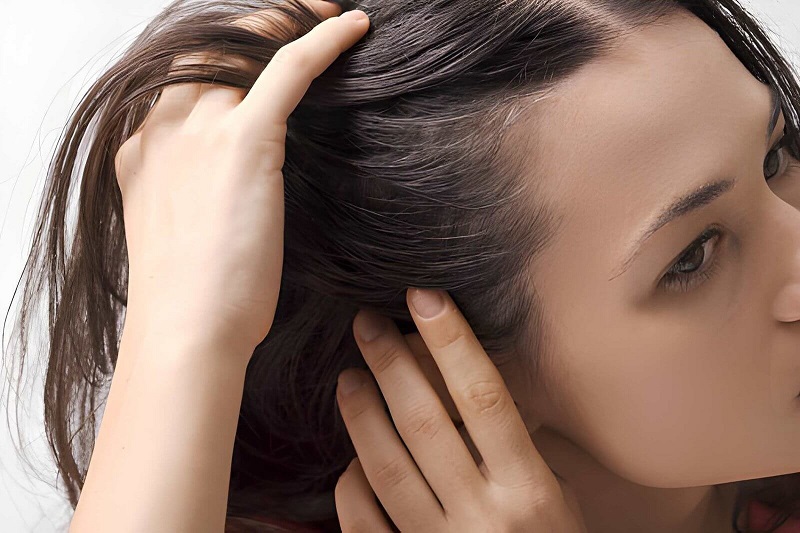
Most people describe healthy hair when you ask them about healthy follicles. Thick strands. Shine. No visible scalp. That’s not wrong, exactly. It’s just backwards.
Hair is the output. The follicle is the factory. And a factory can slow down long before the shipment looks any different.
I’ve noticed this pattern repeatedly while reading through the androgenetic alopecia literature. Follicles shrink gradually, over years, cycling through shorter and shorter growth phases. The person notices nothing. Then, one day, a threshold gets crossed and the mirror looks different. Nothing in between felt like a warning sign. The follicle was still producing hair. Just less of it, for less time, with each cycle.
So the real question behind “hair follicle health” isn’t what a healthy follicle looks like. It’s what would tell you a follicle is starting to struggle, before you can see it. That’s harder to answer. It’s also the only version of this question worth asking.
What a follicle is actually doing
Skip the textbook diagram for a second.
A follicle isn’t a static structure. It behaves more like a small organ, with its own blood supply, its own hormone sensitivity, its own regeneration cycle. At the base sits the dermal papilla, a cluster of cells acting as the follicle’s control center. It signals when to grow, when to rest, when to shed.
What determines whether that signaling goes well? Mostly two things. How well the papilla is fed (blood flow, oxygen, nutrients). And how much interference it’s dealing with (inflammation, hormonal signals, oxidative stress).
Here’s the part worth sitting with: nearly everything people ask about, biotin, scalp massage, a specific shampoo ingredient, ultimately comes down to whether it touches one of those two variables. Most of it touches neither.
The cycle most people misread
Everyone’s read about anagen, catagen, telogen, exogen by now. Fewer people know the part that actually matters for judging follicle health: how long anagen lasts.
Anagen is the active growth phase. Its length is largely genetic, but it’s also sensitive to the same stressors that damage the papilla. A follicle under chronic stress doesn’t necessarily stop growing hair. It just spends less time in anagen with each cycle.
The hair gets shorter before it sheds. It also tends to get finer, because less time in growth means less time to build shaft diameter.
Which raises an odd but useful point: “my hair isn’t growing as long as it used to” is sometimes more meaningful than “I’m shedding more than usual.” Shedding gets attention because it’s visible, on a pillow, in a drain. A shortening anagen phase is invisible unless someone tracks hair length over time. Almost nobody does.
Miniaturization: the slow event nobody catches early
Miniaturization is what happens when follicles shrink, cycle after cycle, producing thinner, shorter, less pigmented hairs until some follicles stop producing visible hair at all.
In androgenetic alopecia, this is driven largely by DHT binding to androgen receptors in genetically susceptible follicles, though the exact downstream mechanism is still debated. Chronic scalp inflammation and localized oxidative stress appear to speed up the same process, independent of hormone levels.
Can it be reversed? I want to be careful here, because this is exactly the kind of question that invites overconfident answers.
The honest answer: it depends on timing, not effort. Follicles that are miniaturizing but still cycling generally respond, to varying degrees, to treatment addressing the underlying driver. Follicles that have gone dormant for a long stretch, or that show signs of fibrosis, are a different story. Once scar tissue replaces the follicular structure, nothing in the research suggests that structure comes back.
That distinction, reversible miniaturization versus fibrotic follicle loss, matters more than almost any product claim. And nobody can look at your scalp and tell you which one you’re dealing with without a proper evaluation. That’s worth saying plainly. A dermatologist, sometimes using trichoscopy or a scalp biopsy, is more useful here than another article. Including this one.
Signs of follicle struggle you might be missing
Most lists of “signs of unhealthy hair” focus on the hair itself: dryness, breakage, dullness. Those matter. But they’re downstream of follicle activity, not indicators of it.
A few signals sit closer to the follicle level:
- Strand diameter change. If new growth feels noticeably finer than hair from a few years ago, especially in one area rather than across the whole scalp, that’s more suggestive of miniaturization than ordinary breakage.
- Regrowth texture after shedding events. Postpartum, illness, major stress. Hair growing back thinner than what was shed suggests the follicles didn’t fully recover their prior cycling. Hair growing back at similar thickness suggests they paused without structurally changing.
- Prolonged shedding. Everyone sheds 50 to 100 hairs a day as part of normal cycling. A short-term spike tied to an identifiable trigger, illness, stress, a diet change, usually resolves within a few months. Elevated shedding that persists for months instead points toward more follicles entering telogen at once.
What the evidence actually supports
I want to grade this honestly rather than hand you a tidy list of equally-weighted tips. That’s usually the point where scalp content quietly turns into marketing.
| Factor | Role in Follicle Health | Evidence Level |
|---|---|---|
| Inflammation control | Limits miniaturization and scarring-related follicle loss | 🟢 Strongest |
| Scalp circulation | Supports nutrient and oxygen delivery to the dermal papilla | 🟡 Plausible, limited data |
| Nutrient status | Matters only when correcting an actual deficiency (iron, vitamin D, protein) | 🟡 Conditional |
| Biotin supplementation | No added benefit absent a diagnosed deficiency | 🔴 Weak, overhyped |
Inflammation control has the strongest evidence base here, mostly because chronic scalp inflammation is a documented contributor to conditions like androgenetic alopecia and several forms of scarring alopecia. It’s less about a specific product and more about treating whatever’s driving the inflammation, seborrheic dermatitis, psoriasis, or something else entirely.
Scalp circulation has reasonable mechanistic logic behind it. Better blood flow should mean better nutrient delivery to the papilla, and a few small studies on scalp massage show modest thickness changes after months of consistent use. Small studies, though, with small effects. Plausible and low-risk. Not proven.
Nutrients are real, but conditional. Iron deficiency, vitamin D deficiency, and inadequate protein intake are associated with shedding and, sometimes, impaired follicle function. Supplementing beyond an actual deficiency shows little to no benefit in the research. Biotin in particular has become a default recommendation despite true deficiency being rare in anyone eating a reasonably varied diet.
Daily care checklist
I’m hesitant to hand over a routine, because daily habits matter less than addressing whatever’s actually driving follicle stress in your specific case. Still, a few things are worth doing rather than dismissing as either miracle or myth.
✅ Reduce inflammation. Treat dandruff or seborrheic dermatitis promptly instead of letting it linger.
✅ Stop guessing at supplements. Extra vitamin A or selenium without confirmed deficiency has been linked to hair shedding in the literature, not prevention of it.
✅ Be patient. A full hair cycle runs months, not weeks. Miniaturization develops slowly. Meaningful change, in either direction, shows up on a similar timeline.
Beyond that, gentle and consistent scalp care, cleansing that doesn’t strip or irritate the skin barrier, does more for follicle function than most people give it credit for. Mostly because it removes one more source of inflammatory interference, quietly, in the background.
FAQ
Where this connects
If you’re trying to work out whether your hair is actually growing, I’ve written separately about how to tell if hair is growing, which covers more direct ways to track growth rate. For the wider question of why hair thins in the first place, what causes hair thinning goes further into the range of contributing factors beyond miniaturization alone. And for the full mechanics of the cycle itself, hair growth cycle stages breaks down anagen, catagen, telogen, and exogen in more depth than fits here.
None of this replaces an actual evaluation if you’re genuinely concerned about hair loss. Research and reader patterns can offer a better framework for understanding what you’re looking at. A dermatologist or trichologist can offer an actual diagnosis specific to your scalp. That’s something no article, including this one, can responsibly give you.